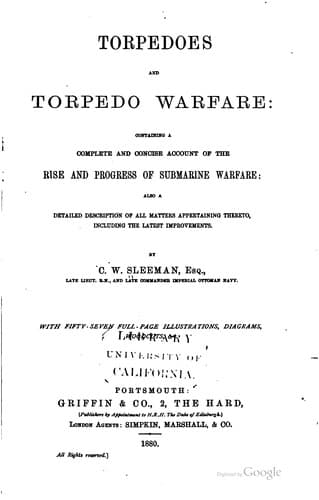
Torpedoes and Torpedo Warfare: Containing a Complete and Concise Account of the Rise and Progress of Submarine WarfareSleeman, Charles William
History
Torpedoes and Torpedo Warfare: Containing a Complete and Concise Account of the Rise and Progress of Submarine Warfare
Sleeman, Charles William
Torpedoes
In the case of the fish torpedo the attack must be conducted in a
different manner, the object in this case being to get within a certain
distance only of the vessel undetected, and from thence send the
missile on its deadly course. The distance should not be more than 500
yards; the closer up to 200 yards the better. In connection with such
an attack, the torpedo boats might be supported by guard boats, whose
particular duty it would be to engage the enemy's guard boats and so
leave the torpedo boats free to do their particular work.
It has been suggested to use the electric light from the bows
of torpedo boats, but this would do away with one of the chief
characteristics of such boats, viz. their invisible and unknown
approach, on which the whole success of the attack in a great measure
depends.
_Fosberry's Patent Torpedo Boat Protective._--To enable torpedo
vessels and boats to remain afloat after being struck by shot from
mitrailleuses, rifles, and other arms usually employed against such
craft, and at the same time to retain their structural lightness,
Colonel G. V. Fosberry, of the English army, has designed the following
method, which is based upon the discovery that when india-rubber or
the like is placed and secured on a metal plate, and is penetrated
or punctured by a rifle bullet or similar projectile, which also
passes through the metal plate, the hole or orifice so formed in the
india-rubber will, after the projectile has passed through it and the
metal plate, immediately be closed by the elasticity of the surrounding
portions, so that no water can follow the projectile through the
said hole or orifice. India-rubber or other elastic material, or
a combination of such materials, in the form of sheets, belts, or
coats, is placed upon or around those portions of the hull of the boat
which are to be protected. Vulcanised or mineralised india-rubber
is the material usually employed by Colonel Fosberry. Between the
metal plates and the india-rubber covering an intermediate substance,
generally kamptulicon, is interposed, which is cemented or riveted to
the said metal plates, and to which the india-rubber is attached. This
intermediate substance, which is the feature of the invention, must be
of such a nature that it may be caused to adhere closely and tightly
to all parts of the metal, and also to the india-rubber covering, while
the same are unperforated, but when the said india-rubber covering and
the metal plate under the same are perforated by a bullet, the portion
of the said intermediate substance adjacent to the perforation must
be detached from the elastic covering and metal plate, and leave the
former free to act like a valve, and close up over the hole so that no
water may enter; and this intermediate substance, as applied by the
inventor in the immediate vicinity of the perforation, will by the
effect of the shot be so broken up and detached from the india-rubber
Public-domain text, read in full here on John Shaqi.
Reviews
Reviews
No reviews yet
Be the first to share your thoughts on this work.
Elsewhere in the archive
Join the Discussion
Join the discussion
Sign in to leave a comment or review.
Sign InorCreate an account