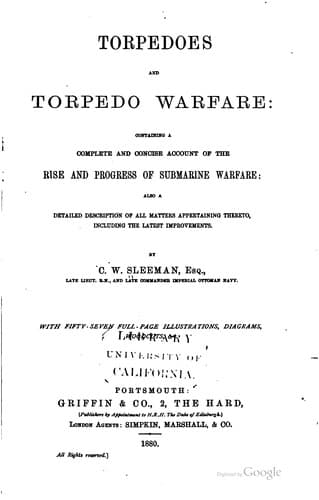
Torpedoes and Torpedo Warfare: Containing a Complete and Concise Account of the Rise and Progress of Submarine WarfareSleeman, Charles William
History
Torpedoes and Torpedo Warfare: Containing a Complete and Concise Account of the Rise and Progress of Submarine Warfare
Sleeman, Charles William
Torpedoes
covering as to allow the same to recover its original position
independently of the new shape or position of the injured and deformed
metal plate.
Should the india-rubber be placed upon the metal plates and be so
attached to the said plates as to adhere and conform to them in
or after their deformation, a hole made in the india-rubber would
remain open; on the other hand, should the india-rubber without any
intermediate substance be attached to the metal plate in such a manner
that it will recover its position after perforation, water would
penetrate between the metal and the india-rubber, and by the pressure
of this water the india-rubber would be liable to be detached from
a large area of the metal plate, and so become ineffective or even
dangerous to the boat. Moreover, if the india-rubber is fixed directly
upon the metal plates, in the case of a shot passing completely through
the boat, that is to say, passing into the boat at one side and out at
the other side, a large portion of the india-rubber adjacent to the
hole made by the shot in leaving the boat will be torn or destroyed,
but this will not be the case in boats constructed according to Colonel
Fosberry's patent.
The French government have recently applied this invention to one of
their torpedo boats with very successful results, thereby proving that
it is not merely a theoretical idea.
_Submarine Boats._--Submarine boats, if they could be constructed to
fulfil the conditions hereinafter enumerated which are essential to a
perfect boat of that nature, would for many reasons be a very important
point solved in connection with torpedo operations, and therefore it is
most extraordinary that a practicable submarine boat has not yet been
designed and built.
_Bushnell's Submarine Boat._--The first submarine vessel built for
torpedo purposes was designed and constructed by David Bushnell in
1775. This vessel, operated by a Sergeant Esra Lee, was employed in an
attempt in 1776 or thereabouts on the _Eagle_, an English man-of-war,
which proved unsuccessful, owing to the sergeant not being thoroughly
versed in the management of his curious craft. She was soon afterwards
sunk in the Hudson river, but was subsequently recovered by the
inventor, though never used again. This vessel was capable of holding
one person, and air sufficient to support him thirty minutes without
receiving fresh air, and is fully described in 'Barnes's Submarine
Warfare.'
_Qualifications essential to a Submarine Boat._--A submarine boat
should possess the following qualifications:--
1.--It should be of sufficient displacement to carry
the machinery necessary for propulsion, and the men and
materials for performing the various operations.
2.--It should be of such a form that it may be easily
propelled and steered.
3.--It should have sufficient interior space for the
crew to work in.
Public-domain text, read in full here on John Shaqi.
Reviews
Reviews
No reviews yet
Be the first to share your thoughts on this work.
Elsewhere in the archive
Join the Discussion
Join the discussion
Sign in to leave a comment or review.
Sign InorCreate an account