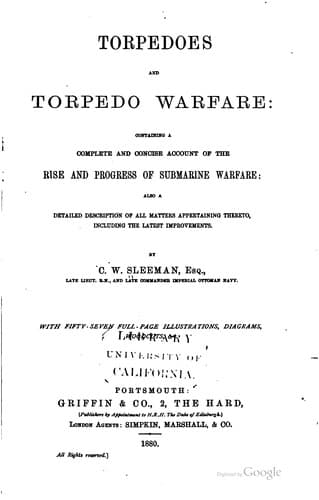
Torpedoes and Torpedo Warfare: Containing a Complete and Concise Account of the Rise and Progress of Submarine WarfareSleeman, Charles William
History
Torpedoes and Torpedo Warfare: Containing a Complete and Concise Account of the Rise and Progress of Submarine Warfare
Sleeman, Charles William
Torpedoes
4.--It should be capable of carrying sufficient pure
air to support its crew for a specified time, or of
having the means of purifying the air within the boat,
and exhausting the foul air.
5.--It should be able to rise and sink at will to the
required depth, either when stationary or in motion.
6.--It should be so fitted that the crew possess the
means of leaving the boat without requiring external
assistance.
7.--It should carry a light sufficient to steer by, and
to carry on the various operations.
8.--It should possess sufficient strength to prevent
any chance of its collapsing at the greatest depth to
which it may be required to manipulate it.
The results of former experiments with such boats prove that manual
power, which was the original mode of propulsion, is not the motive
power best adapted to such a boat; compressed air, gas as used in the
Lay torpedo boat, and steam, are all of them far preferable to the
original method, but which of these modern ones is the most practicable
has yet to be decided.
The most difficult point to be overcome in connection with a submarine
boat is that of steering it correctly when beneath the surface of the
water.
_Confederate Submarine Boat._--The Confederate submarine torpedo
boat that sunk the Federal vessel of war _Housatonic_ on the 17th
of February, 1864, was built of boiler iron, 35' long, 3' beam
(extreme), 5' high in the centre. She carried a crew of nine men. She
was propelled by means of a screw propeller worked by eight of the
crew, her greatest speed being four knots an hour in smooth water.
She carried a sufficient quantity of air to enable the crew to remain
submerged for the space of two to three hours. Two fins were fitted on
the outside for rising and falling at will, when in motion. There were
two manholes provided, fitted with bull's-eyes. This boat was intended
to pass under a vessel's bottom, towing a torpedo after her, which was
arranged to explode on contact. She was the means of drowning fourteen
men before she made her last attempt, when nine others were added to
the above list. In her successful attack on the _Housatonic_, she was
armed with the bow spar torpedo, and was sunk, owing to her running
into the hole formed by the explosion of her torpedo. About three
years after the American civil war was over, this submarine boat was
recovered. Divers went down, and found her lying alongside the hull of
the _Housatonic_, with the remains of the nine men in her.
Public-domain text, read in full here on John Shaqi.
Reviews
Reviews
No reviews yet
Be the first to share your thoughts on this work.
Elsewhere in the archive
Join the Discussion
Join the discussion
Sign in to leave a comment or review.
Sign InorCreate an account