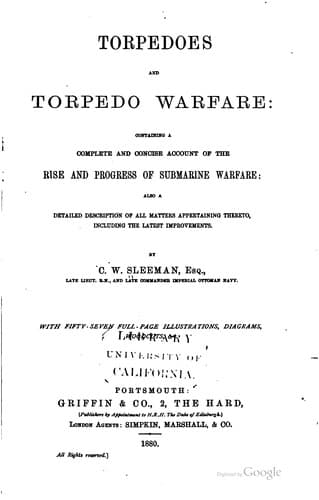
Torpedoes and Torpedo Warfare: Containing a Complete and Concise Account of the Rise and Progress of Submarine WarfareSleeman, Charles William
History
Torpedoes and Torpedo Warfare: Containing a Complete and Concise Account of the Rise and Progress of Submarine Warfare
Sleeman, Charles William
Torpedoes
_The Aluta Attack._--The fifth attack was made on the 30th of June,
1877, on a Turkish monitor off the mouth of the Aluta, in the river
Danube. This attempt, like the last, took place in broad daylight. Four
Russian boats were sent forward, but in spite of the captain of the
Turkish vessel doing all he could to run the boats down, none of them
succeeded in getting sufficiently near the vessel to enable a torpedo
to be placed in contact. The captain of the monitor took the precaution
to rig his lower booms out, and so managed to keep the enemy's boats
at a respectful distance, they imagining that mines were fixed to the
ends of the booms. After two hours of this dodging about, the Russians,
finding the case hopeless, abandoned the attack.
The Russian account states--1st, that the captain of the monitor was an
Englishman; 2nd, that the vessel was protected by nets and torpedoes
lashed to the extremities of her booms--both of which statements are
radically wrong.
The torpedo boats forming the attack were the _Choutka_, Midshipman
Niloff, and the _Mina_, Sub-Lieutenant Arens, both armed with the spar
torpedo.
Unless indeed the Russians acted up to the old proverb which says
"Discretion is the best part of valour," it is difficult to understand
how four small easily handled boats could have been for one hour
endeavouring to strike a ship (which ship was at the same time being
manoeuvred with a view of running them down) without either effecting
their object or being sunk or damaged in the attempt.
The Russians, though unsuccessful, behaved gallantly. Midshipman Niloff
was severely wounded, but no mention is made as to the number of the
crew that were killed and wounded, or of the damage received by the
boats. Niloff received the 4th Class of the Cross of St. George, and
Arens the Order of Military Merit.
The Turkish captain, Ali Bey, behaved most pluckily and skilfully. The
only wonder is that both the boats were not sunk by the monitor's fire.
6TH AFFAIR.
_The Soukoum Kaleh Attack._--The sixth attempt was made on the
23rd-24th of August, 1877, on a Turkish ironclad, the _Assari Shefket_,
at the time lying at anchor off Soukoum Kaleh.[U] Four torpedo boats
composed the attacking force, viz. the _Sinope_, Lieutenant Pisarefski;
the _Torpedoist_, Midshipman Nelson Hirst; the _Navarino_, Lieutenant
Vichnevetski; and the _Tchesme_, Lieutenant Zatzarennyi, the latter
officer being in command. These boats had been brought to the entrance
of the harbour by the _Constantine_, and were despatched on their
mission of destruction about half past ten.
An eclipse of the moon occurred on this night, and, taking advantage of
this fact, the four Russian torpedo boats dashed into the harbour at
full speed and made for the Turkish vessel.
Public-domain text, read in full here on John Shaqi.
Reviews
Reviews
No reviews yet
Be the first to share your thoughts on this work.
Elsewhere in the archive
Join the Discussion
Join the discussion
Sign in to leave a comment or review.
Sign InorCreate an account