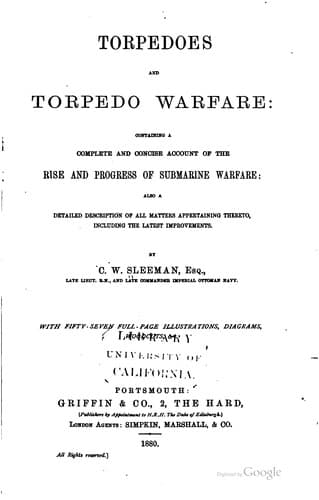
Torpedoes and Torpedo Warfare: Containing a Complete and Concise Account of the Rise and Progress of Submarine WarfareSleeman, Charles William
History
Torpedoes and Torpedo Warfare: Containing a Complete and Concise Account of the Rise and Progress of Submarine Warfare
Sleeman, Charles William
Torpedoes
Fortunately for the safety of his ship and lives of his crew, the
captain of the Turkish ironclad had several boats rowing guard round
his ship, and otherwise everything on board in readiness for immediate
action. On the attacking flotilla nearing the guard boats, blue lights
were burnt, rifles fired, &c., and the alarm given to those on the
look-out in the _Assari Shefket_. The moment the enemy were within
range, such a well-directed and heavy fire was poured on them that
the attack was completely foiled. One of the Russian torpedoes was
exploded, but failed to do more than throw a quantity of water up.
The next morning a pole with torpedo fixed on it was found by the
Turks, and on the strength of this and the numerous fragments of wood
similarly found, one if not more of the enemy's boats it was supposed
must have been sunk, or much knocked about.
This was a much better planned and executed attack, but was
unsuccessful owing to the extreme vigilance of the Turks.
This attempt will always be remembered by the Turks, on account of the
general order that appeared in the papers on the part of the Russians,
in which "the brilliant exploit and successful destruction of the
Turkish ironclad _Assari Shefket_" was set forth at great length; she
at the time that this appeared being quietly at anchor off the dockyard
at Stamboul, not having received any damage whatever.
7TH AFFAIR.
_The Second Batoum Attack._--The seventh attempt was made on the night
of the 27th-28th of December, 1877, on several Turkish men-of-war
anchored in the harbour of Batoum (the scene of the first Russian
torpedo attempt and failure). Four boats composed the attacking force,
viz. the _Tchesme_, Lieutenant Zatzarennyi, in command, armed with a
Whitehead fish torpedo, containing 32 kilog. of gun-cotton, fitted
to fire from a tube under the boat's keel; the _Sinope_, Lieutenant
Stchelinski, armed with a similarly charged fish torpedo, fitted to
fire from a raft, which was towed by the boat, and two other boats,
armed with spar and towing torpedoes.
The means employed at Batoum for the safeguard of the Ottoman fleet
there against such an attack was that of guard boats and a barrier
formed of logs of wood, with planks secured to them, so arranged by
means of weights that the planks remained perpendicular to the surface
of the water when in position.
Owing to the extreme darkness of the night, the Russians managed to
evade the guard boats, and when, as they imagined, some 60 to 65
yards from a Turkish ironclad, the _Tchesme_ and _Sinope's_ Whitehead
fish torpedoes were started on their deadly mission; but, owing most
probably to the want of practice of manipulating these somewhat
delicate instruments, also to the darkness, and the slight swell there
was on at the time, both missed their mark, and were landed high and
dry on the beach astern of the ship.
Public-domain text, read in full here on John Shaqi.
Reviews
Reviews
No reviews yet
Be the first to share your thoughts on this work.
Elsewhere in the archive
Join the Discussion
Join the discussion
Sign in to leave a comment or review.
Sign InorCreate an account