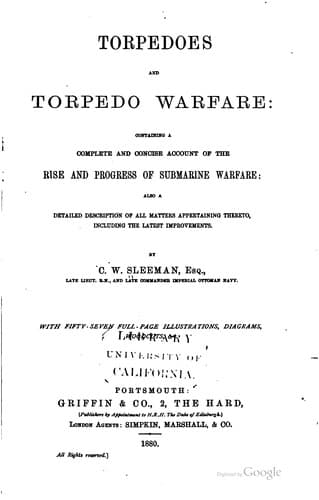
Torpedoes and Torpedo Warfare: Containing a Complete and Concise Account of the Rise and Progress of Submarine WarfareSleeman, Charles William
History
Torpedoes and Torpedo Warfare: Containing a Complete and Concise Account of the Rise and Progress of Submarine Warfare
Sleeman, Charles William
Torpedoes
Explosive _effect_ is _directly_ proportional to the volume of gas
produced and the temperature of the explosion, and _inversely_ as the
time required for the change to take place.
_Explosive Effect and Force compared._--Explosive effect depends upon
the rapidity with which the conversion is effected, while the same
amount of explosive force may act suddenly or gradually.
As before stated, explosions are more or less violent according to the
_circumstances_ under which they take place. These may be considered as
follows:--
1.--The physical state of the explosive substance.
2.--The external conditions under which the explosive body is fired.
3.--The mode of firing.
_The Physical State of the Explosive Substance._--Numerous instances
may be cited to show the influence the physical condition of an
explosive body has upon its explosion.
Thus, gunpowder may, by merely varying the size, shape, and density of
the grain, be made to ignite rapidly but burn comparatively slowly, or
be made to ignite more slowly, but once inflamed to burn very rapidly.
Again, gun-cotton in a loose, uncompressed state, will, if ignited,
only flash off; if it is spun into threads or woven into webs, its rate
of combustion may be so much reduced that it can be used in gunnery
or for a quick fuze; while if powerfully compressed and damp it burns
slowly. Wet gun-cotton requires a primer of dry gun-cotton and a
fulminate fuze to explode; dry, it may be exploded by a fulminate fuze,
&c.
Then nitro-glycerine, when exploded by 15 grains of fulminate of
mercury, and at a temperature above 40° F., is very violently
detonated; below 40° F. it freezes and cannot be similarly exploded.
To obtain the full effect of all explosives, confinement is absolutely
necessary.
The more rapid the explosion the less confinement required, approaching
in the case of some explosives to so small an amount that it need not,
for practical purposes, be considered.
Thus a charge of nitro-glycerine or gun-cotton, when detonated in the
open air, will destroy wrought iron rails, large blocks of stones,
balks of timber, &c.
In the case of the former body, the confinement of the atmosphere is
sufficient.
In the latter, the mechanical cohesion due to compression is sufficient
restraint.
Abel states that if the film of atmosphere surrounding the
nitro-glycerine, not exceeding 1/1000 inch in thickness, be removed,
the explosive effect is much lessened.
A large charge of gunpowder fired in the ordinary way under water
requires a strong case to retain the gases until the action has become
general, or, owing to its slow rate of burning, the case would be
broken before the whole of the charge had been ignited, and part of the
charge drowned.
This is often to be noticed when firing fine-grained powder in heavy
guns.
Igniting the charge at several points diminishes the confinement needed.
Public-domain text, read in full here on John Shaqi.
Reviews
Reviews
No reviews yet
Be the first to share your thoughts on this work.
Elsewhere in the archive
Join the Discussion
Join the discussion
Sign in to leave a comment or review.
Sign InorCreate an account