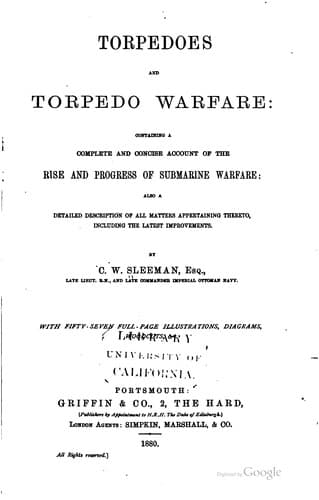
Torpedoes and Torpedo Warfare: Containing a Complete and Concise Account of the Rise and Progress of Submarine WarfareSleeman, Charles William
History
Torpedoes and Torpedo Warfare: Containing a Complete and Concise Account of the Rise and Progress of Submarine Warfare
Sleeman, Charles William
Torpedoes
_Mode of Firing._--The application of heat, directly or indirectly, is
the principal means of causing an explosion.
The flame from a percussion cap or primer, or a platinum wire heated to
incandescence by an electric current, will _directly_ ignite a charge.
Friction, concussion, &c., will _indirectly_ ignite a charge due to the
conversion of mechanical energy into heat.
It would appear that when one explosive body is used as a means of
firing another, the resultant explosion is due to the blow suddenly
formed by the gas of the firing charge acting percussively upon the
mass to be exploded. If such were the case, then the most powerful
explosive would be the best agent for causing an explosion. But it is
not so.
For example, nitro-glycerine, which is far more powerful than fulminate
of mercury, requires more than 1000 grains to explode gun-cotton, while
only 15 grains of the latter is needful for the same work, &c.
A small quantity of an explosive substance which is sensitive to
friction or percussion is often used to ignite the original charge.
_Detonation._--The instantaneous explosion of the whole mass of a body
is defined as "detonation."
The essential difference between an explosion and a detonation is the
comparative suddenness of the transformation of the solid or liquid
explosive substance into gas and vapour.
Some explosive bodies, such as the fulminates, &c., always detonate,
while the detonation of others depends on the mode of firing.
Nitro-glycerine always explodes violently, but when fired with an
initiatory charge of fulminate of mercury it is much more powerful than
when fired with gunpowder.
Compressed gun-cotton in the air-dry state can be detonated by 2 grains
of fulminate of mercury embedded in the material, but when it contains
3 per cent. of water over and above the 2 per cent. which exists
normally in the air-dry substance, 15 grains of the fulminate will not
always do so.
_Theory of Detonation._--The theory of detonation is not yet thoroughly
understood. That it is not alone due to the heat caused by the impact
of the mechanical energy of the particles of gas, set free from the
initiatory charge on the principal mass, is proved by the fact of its
being possible to detonate wet gun-cotton.
Professor Bloxam terms detonation to be "sympathetic" explosion.
Experiments carried on in England by Professor Abel, and in France by
MM. Champion and Pellet, tend to show that it is due to the vibratory
action of the detonating agent.
Thus a glass may withstand a strong blow, though a particular note or
vibration will smash it.
All explosive compounds and mixtures, including gunpowder, are
susceptible of violent explosion through the agency of a detonation.
_Roux and Sarrau._--Roux and Sarrau divide explosions into two orders:--
1st order.--Detonations.
2nd order.--Simple explosions.
Simple explosions are produced by direct inflammation, or by a small
charge of gunpowder.
Public-domain text, read in full here on John Shaqi.
Reviews
Reviews
No reviews yet
Be the first to share your thoughts on this work.
Elsewhere in the archive
Join the Discussion
Join the discussion
Sign in to leave a comment or review.
Sign InorCreate an account