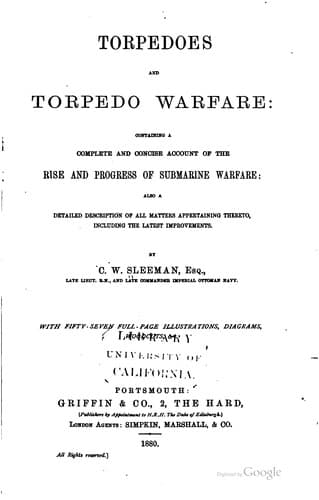
Torpedoes and Torpedo Warfare: Containing a Complete and Concise Account of the Rise and Progress of Submarine WarfareSleeman, Charles William
History
Torpedoes and Torpedo Warfare: Containing a Complete and Concise Account of the Rise and Progress of Submarine Warfare
Sleeman, Charles William
Torpedoes
On being ignited, the oxygen which is feebly held by the nitrogen
combines with the carbon, forming carbonic oxide gas, whilst the
sulphur unites with the potassium of the nitre, the whole combination
being accompanied by a great evolution of heat and expansion of gas,
and the nitrogen is set free.
_Properties, &c._--A spark, friction between hard bodies, or a
temperature of 572° F., are any of them sufficient to cause an
explosion of gunpowder.
Slight moisture, due to damp air, &c., produces caking and
deterioration.
Wetting causes permanent destruction.
Frost does not injure it.
It can be fired by ordinary methods.
It can be transported and handled with safety and great ease.
It is not a suitable explosive agent for torpedoes, on account of its
liability to be injured by damp, as well as its not being sufficiently
violent, though for the sake of convenience, &c., it is often employed
for such work.
The effect produced by the explosion of a charge of gunpowder,
ignited by the ordinary method, is that of an uplifting rather than a
shattering effect.
This evil may be greatly remedied, when gunpowder is used as the charge
of a torpedo, by firing it with a detonator, by which means its fullest
explosive effect is developed.
_Picric Powder._--The picrates are salts of picric acid.
Picric acid is formed by the action of nitric acid on carbolic acid.
The picrate employed by Professor Abel is prepared from picric acid and
ammonium. This preparation, or salt mixed with nitre (saltpetre), forms
Abel's picric powder.
_Properties, &c._--It is prepared for use in a similar manner to
gunpowder, and it can be handled in the same way.
It is less violent than dynamite or gun-cotton, though much more so
than gunpowder.
It is difficult to explode it by blows or friction.
If flame be applied to it, the part touched burns, but the combustion
does not become general.
This explosive agent will probably be used for spar torpedoes, when
gun-cotton or dynamite are not employed.
B.--EXPLOSIVE COMPOUNDS.
_Nitro-glycerine._--Nitro-glycerine is formed by the action of nitric
acid upon glycerine at a low temperature.
The manufacture of this compound consists, first, in the slow mixture
of the glycerine with the acid, at a low temperature; secondly, in
washing the nitro-glycerine from the excess of acid with water.
The nitric acid before use is mixed with a certain proportion of strong
sulphuric acid, so that the water formed during the reaction may be
taken up, and thus any dilution of the nitric acid is prevented.
Nitro-glycerine is composed of carbon, hydrogen, nitrogen, and oxygen,
as indicated by the equation _C_{3}H_{5}N_{3}O_{9}_.
_Properties, &c._--At ordinary temperatures nitro-glycerine is an oily
liquid, having a specific gravity of 1·6. Freshly made it is creamy
white and opaque, but clears and becomes colourless on standing for a
certain time, depending on the temperature.
Public-domain text, read in full here on John Shaqi.
Reviews
Reviews
No reviews yet
Be the first to share your thoughts on this work.
Elsewhere in the archive
Join the Discussion
Join the discussion
Sign in to leave a comment or review.
Sign InorCreate an account