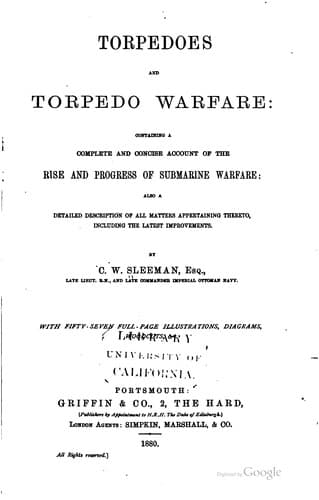
Torpedoes and Torpedo Warfare: Containing a Complete and Concise Account of the Rise and Progress of Submarine WarfareSleeman, Charles William
History
Torpedoes and Torpedo Warfare: Containing a Complete and Concise Account of the Rise and Progress of Submarine Warfare
Sleeman, Charles William
Torpedoes
It does not mix with, nor is it affected by, water. It has a sweet,
aromatic taste, and produces a violent headache if placed upon the
tongue.
The opaque, freshly made nitro-glycerine does not freeze until the
temperature is lowered to 3°-5° below zero, F., but, when cleared, it
freezes at 39°-40° F. Nitro-glycerine freezes to a white crystalline
mass, and in this state it can be thawed by placing the vessel
containing it in water, at a temperature not over 100° F.
If flame is applied to freely exposed nitro-glycerine, it burns slowly
without explosion.
Nitro-glycerine in a state of decomposition becomes very sensitive,
exploding violently when struck, even when unconfined.
Pure nitro-glycerine does not spontaneously decompose at any ordinary
temperature, but if it contains any free acid, then decomposition
may happen. When pure, it is not sensitive to friction, or moderate
percussion. If struck with a hammer, only the particle receiving the
blow explodes, the remainder being scattered.
The firing point of nitro-glycerine is about 356° F., though it begins
to decompose at a lower temperature.
The mode of firing nitro-glycerine usually employed is that of a
fulminate of mercury detonating fuse.
Nitro-glycerine in the frozen state cannot be fired even by large
charges of fulminate.
In one instance, 1600 lbs. of liquid nitro-glycerine exploded in a
magazine containing 600 lbs. of the same substance in a frozen state,
but failed to fire the latter, only breaking it up and scattering it in
every direction.
_Dynamite._--This explosive compound is merely a preparation in which
nitro-glycerine is itself presented for use, its explosive properties
being those of the nitro-glycerine contained in it, as the absorbent is
an inert body.
Dynamite is formed of seventy-five parts of nitro-glycerine absorbed by
twenty-five parts of a porous siliceous earth or "kieselguhr."
The best substitute for "kieselguhr" is ashes of bog-head coal.
Dynamite is a loose, soft, readily moulded substance, of a buff colour.
The preparation of dynamite is very simple.
The nitro-glycerine is mixed by means of wooden spatulas with the fine
white powder (kieselguhr) in a leaden vessel.
It freezes at 39°-40° F., and when solidly frozen cannot be exploded,
but if in a pulverised state it can be exploded, though with diminished
violence.
It can be easily thawed, by placing the vessel containing it in hot
water.
Friction or moderate percussion does not explode it.
Its firing point is 356° F.
If flame be applied to it, it burns with a strong flame.
It is fired by means of fulminate of mercury, and its explosive force
is about seven times that of gunpowder.
For ground and buoyant mines, where actual contact between the hostile
vessel and the torpedo will be rarely achieved, this being next to
nitro-glycerine the most violent of all known explosive agents, and
being cheaply and readily procured, is the very best explosive for such
torpedoes.
Public-domain text, read in full here on John Shaqi.
Reviews
Reviews
No reviews yet
Be the first to share your thoughts on this work.
Elsewhere in the archive
Join the Discussion
Join the discussion
Sign in to leave a comment or review.
Sign InorCreate an account