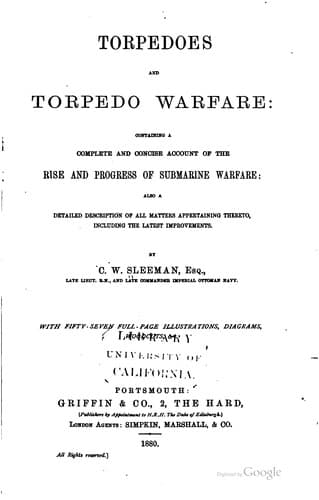
Torpedoes and Torpedo Warfare: Containing a Complete and Concise Account of the Rise and Progress of Submarine WarfareSleeman, Charles William
History
Torpedoes and Torpedo Warfare: Containing a Complete and Concise Account of the Rise and Progress of Submarine Warfare
Sleeman, Charles William
Torpedoes
That it is not generally adopted is owing to its containing a large
proportion of that seemingly dangerous substance, nitro-glycerine,
which makes the handling of dynamite a somewhat hazardous operation.
According to Professor Abel, there are now as many as fifteen dynamite
factories in different parts of the world (including a very extensive
one in Scotland) working under the supervision of Mr. Nobel, the
originator of the nitro-glycerine industry; and six or seven other
establishments exist where dynamite or preparations of very similar
character are also manufactured.
The total production of dynamite in 1867 was only eleven tons, while in
1878 it amounted to 6140 tons.
This explosive compound is most extensively used for general blasting
purposes all over the world, and for this purpose, owing to its
cheapness and the convenience in manipulating it, is far superior to
compressed gun-cotton.
Gun-cotton is formed by the action of concentrated nitric acid
on cotton, its composition being indicated by the formula
_CH_{7}(NO_{2})_{3}O_{5}_.
Professor Abel's process for manufacturing pulped and compressed
gun-cotton is as follows:--
Cotton waste is the form of cotton used; it is picked and cleaned,
thoroughly dried at 160° F., and then allowed to cool.
The strongest nitric and sulphuric acids are employed, mixed in the
proportion of one part of the former to three of the latter by weight.
These are mixed in large quantities, and stored in cast-iron tanks.
The cotton in 1-lb. charges is immersed in the acid mixture, which is
contained in a trough surrounded by cold water. After being subjected
to the action of the acid for a short space of time, the cotton is
taken up, placed upon a perforated shelf, and as much as possible of
the acid squeezed out of it. It is then put into jars, covered with
fresh acid, and the jars placed in fresh water, remaining there for
twenty-four hours.
To remove the acid, the gun-cotton from the jars is thrown into a
centrifugal strainer, by which nearly all the acid is expelled. It is
then diffused quickly in small quantities through a large volume of
water, and again passed through a centrifugal machine.
The next process is that of thoroughly washing the gun-cotton, for the
purpose of removing the traces of the acid still adhering to it. By
pulping, which operation is performed in pulping engines or beaters,
the washing is expeditious and thorough.
A _beater_ is an oblong tub in which is placed a revolving wheel
carrying strips of steel on its circumference. From the bottom under
the wheel project similar steel strips.
The action of this machine is as follows:--
By the rotation of the wheel, the gun-cotton which is suspended in
water circulates around the tub, and is drawn between the two sets of
steel projections, by which it is reduced to a state of _pulp_.
The bottom of the tub is movable, and thus the space through which the
gun-cotton must pass may be contracted, as the operation proceeds.
Public-domain text, read in full here on John Shaqi.
Reviews
Reviews
No reviews yet
Be the first to share your thoughts on this work.
Elsewhere in the archive
Join the Discussion
Join the discussion
Sign in to leave a comment or review.
Sign InorCreate an account