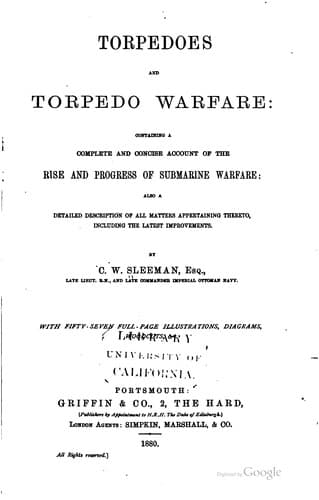
Torpedoes and Torpedo Warfare: Containing a Complete and Concise Account of the Rise and Progress of Submarine WarfareSleeman, Charles William
History
Torpedoes and Torpedo Warfare: Containing a Complete and Concise Account of the Rise and Progress of Submarine Warfare
Sleeman, Charles William
Torpedoes
The column on the left was due to the explosion of a submarine mine
containing 100 lbs. gunpowder at a depth of 10 feet below the surface.
That on the right was the result of an explosion of a similar mine, but
at a depth of 41 feet below the surface. Its extreme height was 400
feet.
CHAPTER IX.
TORPEDO EXPERIMENTS.
THE following are some of the more important torpedo experiments that
have been carried out in England and Europe, to investigate the subject
of submarine explosions as applied to ships and to mines, &c., these
experiments extending over a space of thirteen years.
_Experiment at Chatham, England, 1865._--This experiment was carried
out to ascertain the effect of gunpowder torpedoes on the bottom of a
wooden ship.
Target:--H.M.S. _Terpsichore_, a wooden sloop of war.
Torpedo:--150 lbs. of fine-grained powder. Two were used. They
were placed on the ground, about 13' below the ship's keel, and 2'
horizontally clear of her side.
Effect of explosion:--A hole of about 4' radius was made, about 19'
nearly vertical from the charge; the _Terpsichore_ sinking a few
minutes after the explosion.
_Experiment in Austria._--The object of this experiment was to
ascertain the effect of a very large charge of gun-cotton exploded at
some distance from the side of a wooden vessel.
Target:--A wooden sloop.
Torpedo:--400 lbs. of gun-cotton, placed 10' below the surface of the
water, and 24' horizontally from the bottom of the vessel.
Effect of explosion:--Complete destruction of the vessel.
_Experiments at Carlscrona, Sweden, 1868._--These experiments were
made to investigate the effect of submarine contact mines, charged
with dynamite, against a strong wooden vessel, as well as against
a double-bottomed iron vessel. They were carried out under the
supervision of Lieut.-Colonel Zethations, of the Royal Swedish Navy.
Target:--The hull of a 60 gun frigate, which had been built in 1844;
it had been cut down to the battery deck, and the copper removed.
Her timbers and planking were quite sound; timbers of oak about
13" square, and 1" apart; planking of Swedish pine, 5-1/2"; bottom
strengthened inside with wrought-iron diagonal bands, 6" by 1-1/4";
inside planking running half way up to the battery deck of oak; 6"
thick. This completes the wooden target.
On the port side a quadrangular opening was made, and fitted with a
construction representing a strong double iron bottom, firmly fastened
to an oaken frame that had been put on inside, on the four sides of the
opening, and with through-going bolts, 1" in diameter, to the timbers.
Torpedoes:--No. 1.--13 lbs. dynamite, enclosed in 1/12" iron case. It
was placed on the starboard side, amidships, 7' below the water line,
and 2' 2" from the bottom of the ship.
No. 2.--16 lbs. dynamite, enclosed in a glass vessel. It was placed on
the starboard side, 7-3/4' below the water line, 3' from the bottom of
the ship, and 40' from her stern.
Public-domain text, read in full here on John Shaqi.
Reviews
Reviews
No reviews yet
Be the first to share your thoughts on this work.
Elsewhere in the archive
Join the Discussion
Join the discussion
Sign in to leave a comment or review.
Sign InorCreate an account