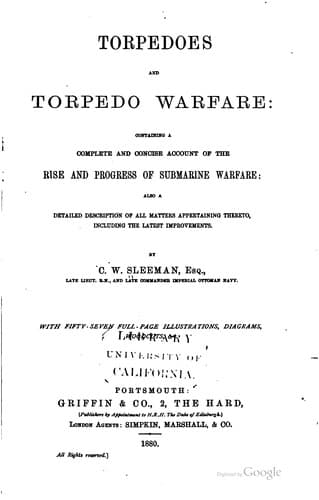
Torpedoes and Torpedo Warfare: Containing a Complete and Concise Account of the Rise and Progress of Submarine WarfareSleeman, Charles William
History
Torpedoes and Torpedo Warfare: Containing a Complete and Concise Account of the Rise and Progress of Submarine Warfare
Sleeman, Charles William
Torpedoes
_Experiment in England, 1874._--Target:--A rectangular iron case 20'
long, 10' high, and 8' wide, divided into six compartments by means of
one longitudinal bulkhead midway between the front and rear faces of
the target, and two athwartship bulkheads equidistant from the ends of
the target. Thickness of front and rear faces 11/16", of longitudinal
bulkhead 1/4", of athwartship bulkheads 3/8".
Torpedo:--100 lbs. of gunpowder, enclosed in a spar torpedo case and
fired by two detonators. It was exploded in contact with the target,
7-1/2' below the surface of the water, and 7' from top of target.
Effect of explosion on the target:--"Front of centre compartment
destroyed and top blown off. Plate representing inner skin destroyed.
Back of centre compartment (rear face of the target) much bulged, and
penetrated; the hole measured 36' × 15". Large portions of the target
were thrown to a height of 150 to 200 feet, and from 80 to 100 yards'
distance."
The effect of explosion on a ship's pinnace, which had been placed
16 feet from and at right angles to the front face of the target,
with steam up, and canopy and shield in position, was that a large
quantity of water was thrown back in the boat, putting the fires out,
and filling the boat up to her thwarts, but otherwise the boat was
uninjured.
_Experiments at Copenhagen, Denmark, in 1874._--The object of these
experiments was to ascertain if a ship's armoured side would be
seriously injured by a torpedo exploded in contact with it.
1ST EXPERIMENT.
Target:--1" thick, and 2' × 2', supported in a horizontal position on a
substructure consisting of 8" timber resting on two pieces of 6" timber
under two sides, and completely supported by earth up to lower edge of
substructure.
Torpedo:--33 lbs. of dynamite, enclosed in a square wooden case 2-1/4"
high, and 5·5" × 5·5"; it was placed on the middle of the earth with 8"
of earth tamping; this tamping representing the resistance of a thin
stratum of water.
Effect of explosion:--The plate was broken into four pieces, and
substructure crushed.
2ND EXPERIMENT.
Target:--2" thick, and 2' × 2-1/2', supported in a horizontal position
on a substructure as above, but resting on four piles of 6" x 6" timber.
Torpedo:--8·9 lbs. of dynamite, enclosed in a wooden case 4" high, and
5" × 10". It was laid with one edge on the plate, the other edge 3"
above the plate; same tamping as above.
Effect of explosion:--The plate broken into three pieces, and
substructure crushed.
3RD EXPERIMENT.
Target:--5" thick, and 3' 8" × 4' 7", supported in a horizontal
position on a substructure as above, but eight piles of 6" × 6" timber
used. Plate bolted to the structure with eights.
Torpedo:--44·4 lbs. of dynamite, enclosed in a wooden case, of same
thickness as the Harvey torpedo, and 4" × 13" × 21"; it was placed with
surface against the plate, one edge 2" and the other 5-1/2" from the
plate; tamping as before.
Public-domain text, read in full here on John Shaqi.
Reviews
Reviews
No reviews yet
Be the first to share your thoughts on this work.
Elsewhere in the archive
Join the Discussion
Join the discussion
Sign in to leave a comment or review.
Sign InorCreate an account