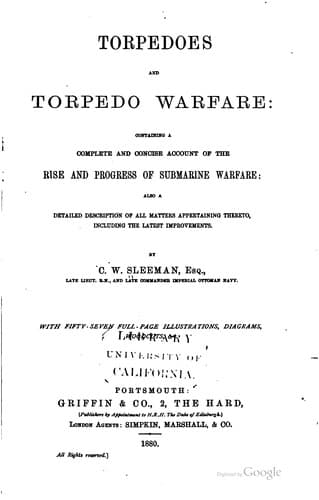
Torpedoes and Torpedo Warfare: Containing a Complete and Concise Account of the Rise and Progress of Submarine WarfareSleeman, Charles William
History
Torpedoes and Torpedo Warfare: Containing a Complete and Concise Account of the Rise and Progress of Submarine Warfare
Sleeman, Charles William
Torpedoes
_THEORY of Electricity._--The theory most readily understood, and which
most satisfactorily explains the various electrical phenomena, is as
follows:--
"That every substance and every atom of the world is pervaded by a
peculiar, subtle, imponderable fluid which is termed _Electricity_,
but which is not known to exist, or remains in a state of _electrical
equilibrium_, until evoked by certain causes."
The effect of causing a disturbance of this equilibrium is to increase
the normal, or natural, electricity in some particles, and to equally
decrease it in other particles, i.e. what one loses the other gains.
An excess of natural electricity is denoted by the term _positive_,
or mathematical symbol (+) while a deficiency is denoted by the term
_negative_, or symbol (-).
_Like electricities repel each other._
That is to say, two bodies charged with an excess of, or positive,
electricity, being brought together repel each other, neither wishing
to increase the excess that has been evoked in them.
Similarly in the case of two bodies charged with a deficiency of, or
negative, electricity, neither wish to add to the deficiency already
there.
In both these cases there can be no tendency to electrical equilibrium,
which is the principle at work. In the former case, there being already
too much, more will but increase the disturbance.
In the latter case, further deficiency will but add to the irregularity.
_Unlike electricities attract each other._
That is to say, if two bodies, one charged with positive, or having an
excess of electricity, the other charged with negative, or having a
deficiency of electricity, be brought together, they will attract each
other; both being desirous of altering their existing state, the one
by decreasing its excess, and the other by decreasing its deficiency of
electricity.
In this case, there will be a tendency to equilibrium, caused
by attraction. The earth is supposed to be a vast reservoir of
electricity, from which a quantity can be drawn to fill up a
deficiency, and which is always ready to receive an excess from
other bodies. Every body in nature has its own natural quantity
of electricity, and when an object is negatively electrified, or
has a deficiency in its normal quantity, there is a tendency to
receive a supply from any convenient source. Such an object would
receive electricity from the earth if means were afforded; and a
body _positively_ electrified, would tend to part with its excess in
the same manner. Where such facilities for establishing electrical
equilibrium are afforded, the result is the passage of a _current_ of
electricity.
Public-domain text, read in full here on John Shaqi.
Reviews
Reviews
No reviews yet
Be the first to share your thoughts on this work.
Elsewhere in the archive
Join the Discussion
Join the discussion
Sign in to leave a comment or review.
Sign InorCreate an account