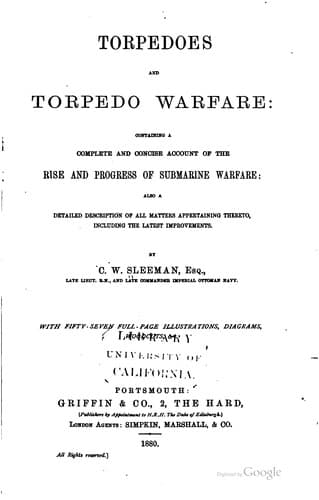
Torpedoes and Torpedo Warfare: Containing a Complete and Concise Account of the Rise and Progress of Submarine WarfareSleeman, Charles William
History
Torpedoes and Torpedo Warfare: Containing a Complete and Concise Account of the Rise and Progress of Submarine Warfare
Sleeman, Charles William
Torpedoes
_Conductors._--Sensible effects can be produced by electricity at great
distances from the source, provided there be a medium of communication,
that is, good _conductors_ to transfer it. When a glass rod is rubbed
with a piece of silk, it becomes charged with an excess of, or
positive, electricity, and at the same time the silk becomes charged
with negative electricity.
The glass rod will retain the positive electricity upon it for some
time, unless touched with the wet hand, a wet cloth, a metal, &c., when
it will instantly cease to be electrified. The electricity is then said
to have been conducted away, and the bodies which allow it to run off
the glass are called _conductors_ of electricity. Metals, water, the
human body, charcoal, damp wood, and many other bodies are conductors.
Those bodies which conduct electricity hardly at all, such as the air,
silk, glass, sealing wax, gutta percha, india rubber, &c., are termed
_nonconductors_ or _insulators_.
Strictly speaking, all substances _conduct_ electricity in some degree,
and a _nonconductor_ is merely a _bad_ conductor.
In the following table the bodies are arranged in their order of
conductivity, i.e. each substance conducts better than that which
precedes it; the first-named body is the best insulator, and the
last-named one is the best conductor.
Dry air.
Ebonite.
Paraffin.
Shellac.
India rubber.
Gutta percha.
Resin.
Sulphur.
Sealing wax.
Glass.
Silk.
Wool.
Dry paper.
Porcelain.
Dry wood.
Stone.
Pure water.
Rarefied air.
Sea water.
Saline solutions.
Acids.
Charcoal, or Coke.
Mercury.
Lead.
Tin.
Iron.
Platinum.
Zinc.
Gold.
Copper.
Silver.
Though two substances are near one another in the above list, they do
not necessarily approach one another in their power of conducting. For
instance, taking the conducting power of pure silver as represented by
the number 100, then
Pure Copper will be equal to 99·9,
Gold will be equal to 78·0,
while Zinc will be only equal to 29·0,
and pure water, which is half-way down the list, will offer 6,754
millions more resistance than silver to the passage of the electric
current.
The metals being the best known conductors, are usually employed as the
means of transferring the electric current from one place to another.
_Electric Circuit._--The conditions attending this operation are
different from those of any other known method of transmission.
A complete _circuit_ must always be formed by the electric current,
i.e. it cannot start from one place _A_, travel to another place _B_,
and cease there, but the current must be completed before it can be
said to have reached _B_. There cannot be a current of electricity
without a means of recombination, which recombination must be at the
_source_, or place of original disturbance.
Public-domain text, read in full here on John Shaqi.
Reviews
Reviews
No reviews yet
Be the first to share your thoughts on this work.
Elsewhere in the archive
Join the Discussion
Join the discussion
Sign in to leave a comment or review.
Sign InorCreate an account