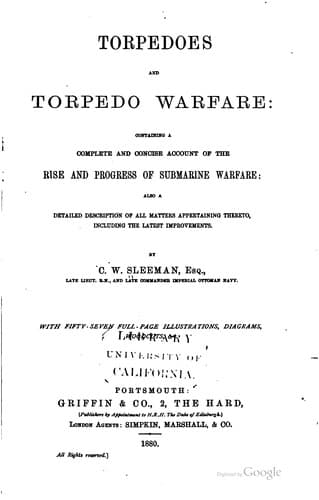
Torpedoes and Torpedo Warfare: Containing a Complete and Concise Account of the Rise and Progress of Submarine WarfareSleeman, Charles William
History
Torpedoes and Torpedo Warfare: Containing a Complete and Concise Account of the Rise and Progress of Submarine Warfare
Sleeman, Charles William
Torpedoes
1.--By _chemical action_.
2.--By _friction_.
_By Chemical Action._--_Chemical action_ is the chief source of free
electricity, the representative of which is the galvanic, or Voltaic,
battery.
The electricity so generated is also termed dynamical electricity, due
to there being a constant electric current, so long as the poles of the
battery producing it are kept closed; the electricity being thus in a
_dynamic_ or moving state.
By chemical action is signified that which occurs when two or more
substances so act upon one another as to produce a third substance
differing altogether from the original ones in its properties, or when
one substance is brought under such conditions that it forms two or
more bodies differing from the original ones in their properties.
_Definition and Properties of a Voltaic Cell._--The _Voltaic_ cell
consists of an insulating jar, containing a liquid, in which are
placed two plates or pieces of dissimilar metals; the liquid must be
composed of two or more chemical elements, one of which at least tends
to combine with one or other of the metals, or _with both in different
degrees_.
By a Voltaic _battery_ is meant a number of cells above one; this term,
however, is often applied to a single cell when working by itself.
A "_simple_ Voltaic cell," "element," or "couple," consists of two
metals placed in a conducting liquid. If two metals--for instance, zinc
and copper--are placed in water slightly acidulated, without touching
each other, no effect is apparent; but if they be made to touch,
bubbles of hydrogen gas are formed over the copper plate, and continue
forming these until the plates are separated. After being in contact
for some time, the copper plate will be found unaltered in weight,
but the zinc plate will have lost weight, and the portion so lost
will be found in the liquid in the form of sulphate of zinc. The same
effects are also produced by connecting the two plates by means of some
conducting substance, instead of placing them in contact.
Zinc is invariably employed as one of the metal plates, on account of
the ease with which it dissolves in dilute acids; and the greatest
results are obtained when the second metal plate is not acted upon
at all by the liquid, for then the whole effect due to the oxidation
of the zinc plate is obtained; but when the second plate is also
chemically acted upon, then only the effect due to the difference
between the two chemical actions is obtained, for, as will be explained
further on, they each act in directly opposite directions.
_Voltaic Current._--The Voltaic current makes its appearance under the
general laws of electrical action.
Public-domain text, read in full here on John Shaqi.
Reviews
Reviews
No reviews yet
Be the first to share your thoughts on this work.
Elsewhere in the archive
Join the Discussion
Join the discussion
Sign in to leave a comment or review.
Sign InorCreate an account