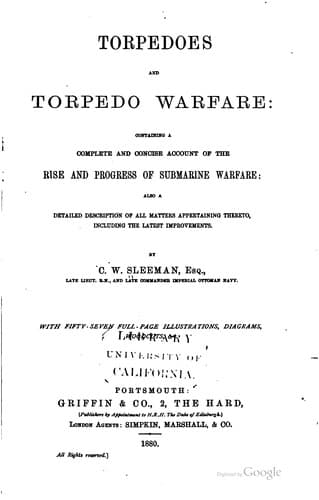
Torpedoes and Torpedo Warfare: Containing a Complete and Concise Account of the Rise and Progress of Submarine WarfareSleeman, Charles William
History
Torpedoes and Torpedo Warfare: Containing a Complete and Concise Account of the Rise and Progress of Submarine Warfare
Sleeman, Charles William
Torpedoes
When a body charged with an _excess_ of, or _positive_, electricity,
is connected with the earth, electricity is transferred _from_ the
charged body to the earth; and similarly when a body is charged with
a _deficiency_ of, or _negative_, electricity, is connected with the
earth, electricity is transferred _from_ the earth to the body.
Generally whenever two conductors in different electrical conditions
are put in contact, electricity will flow from one to the other.
That which determines the direction of the transfer is the relative
_potential_ of the two conductors. Electricity always flows from a body
at _higher potential_ to one at _lower potential_, when the two are in
contact, or connected by a conductor. When no transfer of electricity
takes place under these conditions, the bodies are said to be at the
_same potential_, which may be either _high_ or _low_. The _potential_
of the earth is assumed to be _zero_.
_Definition of Potential._--"The _potential of a body or point, is
the difference between the potential of the body or point, and the
potential of the earth_."
Difference of potential for electricity is analogous to difference
of level for water. Now, since, when a metal is placed in a vessel
containing a liquid, electricity is produced, the liquid becomes of a
different potential to the metal, each being electrified in an opposite
way; and therefore, as above stated, there being a _difference_ of
potentials, electricity will tend to flow from one to the other.
This is evidence of a _force_ being in action, for there can be no
motion without some force to produce it.
_Electro-motive Force._--_Electro-motive force_ is the name given to a
peculiar force to which is due the property of producing a difference
of potentials. When it is said that zinc and water produce a definite
electro-motive force, what is meant is, that by their contact a certain
definite difference of potentials is produced.
The _electro-motive force_ of a Voltaic element may be termed its
_working_ power, in the same way as the pressure of steam is the
working power of a steam engine, though this is not to be considered as
the real source of power, which, as will be seen, is uncertain. Due
to the difference of potential of the metal and the liquid, a current
of electricity will flow from one to the other, causing the chemical
decomposition of the liquid, and the reaction may be taken as the
origin of the power employed.
But while the expenditure of energy (which is necessary to produce a
_force_) is accounted for by taking the chemical action as the source
of power, the preceding cause of this chemical action, viz. the flowing
of the current of electricity due to the difference of potential of the
metal and the liquid, must also have first involved the expenditure of
energy; thus the real source of power is very uncertain.
Public-domain text, read in full here on John Shaqi.
Reviews
Reviews
No reviews yet
Be the first to share your thoughts on this work.
Elsewhere in the archive
Join the Discussion
Join the discussion
Sign in to leave a comment or review.
Sign InorCreate an account