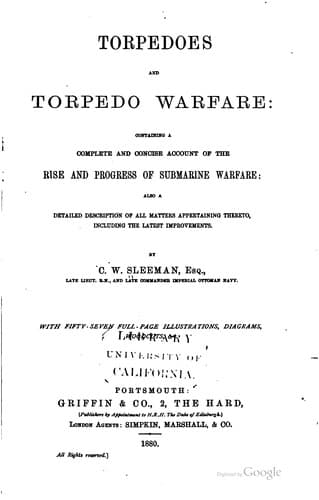
Torpedoes and Torpedo Warfare: Containing a Complete and Concise Account of the Rise and Progress of Submarine WarfareSleeman, Charles William
History
Torpedoes and Torpedo Warfare: Containing a Complete and Concise Account of the Rise and Progress of Submarine Warfare
Sleeman, Charles William
Torpedoes
_Electrolytes._--As before stated, a Voltaic cell consists of two
plates of dissimilar metals, which must be immersed in a liquid
composed of two or more chemical elements, one of which at least will
combine with one or other of the metals, or both in a different degree.
Those liquids which are thus decomposed by the passage of a current of
electricity are termed _electrolytes_.
The elements, then, forming the electrolyte may have chemical affinity
for both metals, though in a greater degree for one than the other.
"Oxygen" is the most important element of an electrolyte, and to the
_affinity for oxygen of the metals_ is the magnitude of the result and
effect.
_Terms Electro-positive and Electro-negative._--All metals have a
definite relation to each other as to the potential which any one may
have when brought into contact with another. Thus, when zinc is brought
into contact with copper, the former has a potential positive to the
latter, i.e. a current of electricity will tend to flow from the zinc
to the copper. The metals may be so placed in a list that each one
would be positive to any of those that follow it; it is then said to be
electro-positive to them, and they are electro-negative to it. As those
metals which are electro-positive to others have a greater affinity for
oxygen, and those that are electro-negative to others a less affinity
for this element, the terms electro-positive and electro-negative
signify, in effect, greater or less affinity for this element.
Conversely, oxygen will combine more readily with the former than with
the latter.
The following list shows the commoner metals arranged in
electro-chemical order.
+ Zinc.
Lead.
Tin.
Iron.
Antimony.
Copper.
Silver.
--Gold.
Take the case of a Voltaic cell composed of zinc and copper plates
immersed in water.
The passage of electricity through the water will decompose it into its
elements hydrogen and oxygen, the latter having an affinity for both
the plates, but considerably more so for the zinc plate.
Then, an electro-motive force will be generated at each metal, and
these forces will act in opposition to each other, but the greater
strength of the one will overcome the weaker, and the real power of the
electric current will be the difference between the two.
_Definition of "Elements."_--The battery plates are termed the positive
and negative _elements_. A Voltaic battery has two _poles_--a positive
and a negative--which are the terminations of the plates.
Public-domain text, read in full here on John Shaqi.
Reviews
Reviews
No reviews yet
Be the first to share your thoughts on this work.
Elsewhere in the archive
Join the Discussion
Join the discussion
Sign in to leave a comment or review.
Sign InorCreate an account