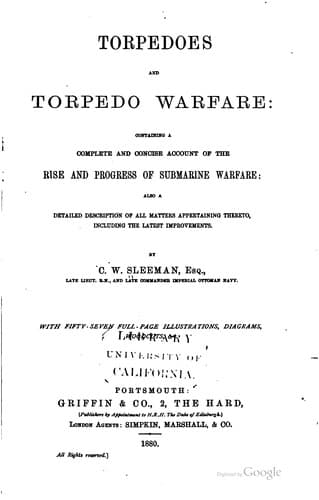
Torpedoes and Torpedo Warfare: Containing a Complete and Concise Account of the Rise and Progress of Submarine WarfareSleeman, Charles William
History
Torpedoes and Torpedo Warfare: Containing a Complete and Concise Account of the Rise and Progress of Submarine Warfare
Sleeman, Charles William
Torpedoes
_Definition of the term Polarisation._--The word _polarisation_ means
that the plates become coated with the products of the decomposition
of the _electrolyte_, producing a diminution of current. In the above
described battery, the hydrogen gathers on the surface of the copper
plate, and an _electro-motive force_ is set up which counteracts
the electro-motive force producing the current--the copper plate is
said to be _polarised_. By the bubbles of hydrogen collecting on the
face of the negative plate, the _surface_ in contact with the liquid
is gradually decreased; thus the plate becomes practically smaller,
and a single fluid cell which at starting gave a good current soon
shows that it is really weakened. The consequence is that the zinc is
consumed extravagantly as well as the acid, and the cell working with
poor results. Also the _resistance_ of the cell is increased, due
to the sulphuric acid, which is added to the water to increase its
conductivity, being gradually used up, by combining with the oxide (see
plan) and forming sulphate of zinc. Liquids are very bad conductors
of electricity; the greater part of the ordinary internal resistance
of a battery arises from this cause. The common sand battery is the
worst of all batteries as regards constancy of electro-motive force,
the _polarisation_ being greater in this battery than any other because
the gas cannot readily escape. The common copper and zinc cell is the
next in order of demerit. The _Smee_ single fluid cell, in which the
negative plate is a platinum instead of a copper one, is better than
the copper zinc cell, because the free hydrogen does not stick to the
rough surface of the platinum plate so much as to the copper.
_Double Fluid Batteries._--All the defects of the single fluid battery,
which are as follows--
1. Diminution of electro-motive force,
2. Inconstancy,
3. Increase of internal resistance,
are remedied in the _double fluid_ battery, of which the _Daniell's
cell_ was the first invented, and is a good example. Of this kind of
cell many forms are in use, but the principle is the same throughout.
There is a positive and negative element, and the cell is divided
into two receptacles for the two fluids. In the most constant form
of Daniell cell, the zinc is plunged into a semi-saturated solution
of sulphate of zinc, the copper in a saturated solution of sulphate
of copper, and these two solutions are separated either by a porous
barrier, or by taking advantage of the different specific gravities of
the two solutions. By a _saturated_ solution is meant a liquid which
has dissolved as much of the substance as it possibly can.
_The Chemical Action of a Daniell Cell._--The chemical action of this
form of Daniell cell is as follows:--
Public-domain text, read in full here on John Shaqi.
Reviews
Reviews
No reviews yet
Be the first to share your thoughts on this work.
Elsewhere in the archive
Join the Discussion
Join the discussion
Sign in to leave a comment or review.
Sign InorCreate an account