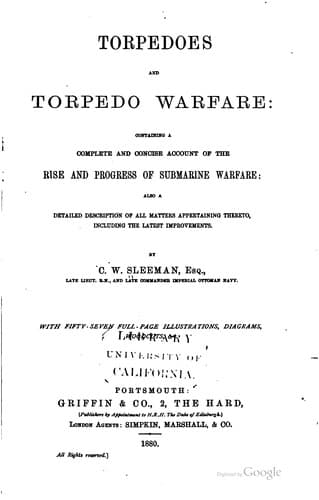
Torpedoes and Torpedo Warfare: Containing a Complete and Concise Account of the Rise and Progress of Submarine WarfareSleeman, Charles William
History
Torpedoes and Torpedo Warfare: Containing a Complete and Concise Account of the Rise and Progress of Submarine Warfare
Sleeman, Charles William
Torpedoes
The zinc electrode combines with oxygen; the oxide thus formed
combines with sulphuric acid and forms sulphate of zinc. Oxide of
copper is separate from the sulphate; and the copper in this oxide
is separated from the oxygen. The oxygen of the water is separated
at the zinc electrode from the hydrogen, and at the other electrode
this hydrogen recombines with the oxygen from the oxide of copper.
This alternate decomposition and recombination of the elements of
water can neither increase nor decrease the E.M.F. of the cell, the
actions being equal and opposite. The result of the series of actions
above described is that the sulphuric acid and oxygen of the sulphate
of zinc are transmitted to the zinc, combine with it, and form fresh
sulphate of zinc; the sulphuric acid and oxygen of the sulphate of
copper are transmitted to the zinc set free by the above process, and
reconvert it into sulphate of zinc; the copper of the sulphate of
copper is transmitted to the copper electrode, and remains adhering
to it. The whole result is therefore the substitution of a certain
quantity of sulphate of zinc for an equivalent quantity of sulphate of
copper, together with a deposition of copper on the copper or negative
electrode.[X] The following is a plan of the process:--
Zinc............} } .{ Sulphate of Zinc found
} Oxide of Zinc..} . { at positive plate.
Water { Oxygen..} }.
{ Hydrogen.................}......}
{ Sulphuric Acid.....} } Water.
Sulphate of { { Oxygen..}
Copper { Oxide of Copper { { Copper at negative
{ Copper....{ plate.
_Description of the "Callaud" and "Marié-Davy" Batteries._--The Voltaic
batteries in general use for the different purposes of torpedo warfare
have been fully described in Chapter IV., and therefore it will be
only necessary here to explain the construction of the "Callaud" and
"Marié-Davy" batteries, these being much used abroad in connection with
telegraphy.
The _Callaud_ cell, named from the inventor, is a modification of the
Daniell cell, and is also called a _gravity_ battery, the liquids
being simply prevented from mixing by the law of gravity forbidding
the heavier of the two from rising through the lighter. It consists
of a thin plate of copper, which is laid on the bottom of a good
_insulating_ jar having an _insulated_ wire leading up the side, and
on this plate are placed crystals of sulphate of copper. A solution of
sulphate of zinc is then poured in, and on the top is fitted a zinc
plate, which forms the positive element. The vessel must not be shaken,
or the sulphate of copper when dissolving will mix with the solution
above it.
The _Marié-Davy_ cell consists of a carbon electrode in a paste of
proto-sulphate of mercury and water contained in a porous pot, and a
zinc electrode in dilute sulphuric acid, or in sulphate of zinc.
Public-domain text, read in full here on John Shaqi.
Reviews
Reviews
No reviews yet
Be the first to share your thoughts on this work.
Elsewhere in the archive
Join the Discussion
Join the discussion
Sign in to leave a comment or review.
Sign InorCreate an account