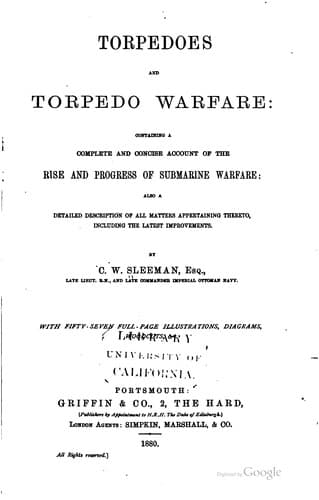
Torpedoes and Torpedo Warfare: Containing a Complete and Concise Account of the Rise and Progress of Submarine WarfareSleeman, Charles William
History
Torpedoes and Torpedo Warfare: Containing a Complete and Concise Account of the Rise and Progress of Submarine Warfare
Sleeman, Charles William
Torpedoes
The late Professor Faraday has proved that one cell of a Voltaic
pile possesses the same quantity of electricity as an ordinary sized
frictional machine after being wound round 800,000 times, thus
showing the contrast between the qualities of frictional and Voltaic
electricity.
The electricity of the frictional machine and that of the galvanic
battery may be made to produce the same effect, there being no
difference in kind between them. Frictional electricity can be made
to pass in a current, but it is comparatively feeble. Again, Voltaic
electricity can be made to produce a spark, but under ordinary
circumstances it scarcely amounts to anything.
_Description of a Frictional Electric Machine._--A frictional
electrical machine consists of a vulcanite or glass disc or cylinder,
which is made to revolve between cushions or rubbers of leather or
silk. By the friction the (silk) rubbers become negatively, and the
glass disc or cylinder positively, electrified. The revolving disc
immediately after contact with the fixed rubbers passes close by a
series of brass points, which are connected with a _condenser_. These
points collect the positive electricity of the glass, the rubbers
being put to earth. The positive electricity which the glass loses is
supplied through the rubber; a stream of negative electricity flows
from the rubbers to the earth during the charging of the conductor or
condenser; in other words, the positive electricity flows from the
earth to the rubber, whence it crosses to the glass disc and so to the
condenser.
_Definition of a "Condenser."_--A _condenser_ is an arrangement for
accumulating a large quantity of electricity on a comparatively small
surface.
_The "Leyden Jar."_--The _Leyden jar_, which is the original type of
the condenser, or accumulator, consists of a glass jar coated inside
and out, up to within a few inches of the mouth, with tinfoil pasted
on, but having no connection with each other. The mouth is usually
closed by means of a wooden stopper, through which a brass rod passes,
to the head of which is affixed a brass knob, &c., the rod and knob
being metallically connected with the _inner_ coating by means of a
chain.
The "Leyden jar" may be charged either by connecting the _outer_
coating to earth (the rubbers of the machine being also to earth),
and the _inner_ coating to the conductor of the machine; or else by
connecting the outer coating to the rubbers, and the inner coating to
the conductor, a complete circuit being necessary to charge the jar as
highly as the frictional electrical machine will admit of.
The _conductor_ of the machine being charged, also forms a kind of
Leyden jar, the conductor in this case being the inner coating, the
air, the _dielectric_, and the nearest surrounding conductors, such as
the walls of the room, &c., being the outer coating.
_Meaning of "Dielectric."_--By _dielectric_ is meant a non-conducting
medium, which in the case of the "Leyden jar" is the glass.
Public-domain text, read in full here on John Shaqi.
Reviews
Reviews
No reviews yet
Be the first to share your thoughts on this work.
Elsewhere in the archive
Join the Discussion
Join the discussion
Sign in to leave a comment or review.
Sign InorCreate an account