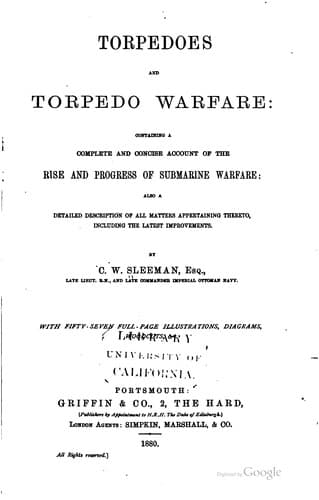
Torpedoes and Torpedo Warfare: Containing a Complete and Concise Account of the Rise and Progress of Submarine WarfareSleeman, Charles William
History
Torpedoes and Torpedo Warfare: Containing a Complete and Concise Account of the Rise and Progress of Submarine Warfare
Sleeman, Charles William
Torpedoes
If the conductor between the battery poles be such that the _external_
resistance _x_ may be practically left out, then C = E / _r_, and no
change in the strength of the current will be effected by adding any
number of cells in series, as _r_ will increase equally with _E_, and
therefore _C_ will remain the same; but if under the same conditions
the cells be joined in _multiple arc_, then _r_ will decrease as _E_
increases, and therefore _C_ will be increased.
Thus with a short circuit of small external resistance, the strength of
the current will be increased by increasing the size of the plates, or
by joining the cells in multiple arc, but not in series.
If the conductor between the poles of the battery be such that the
external resistance _x_ becomes very great, then C = E / (_x_ + _r_),
where _x_ is very great compared to _r_. By joining the cells in
multiple arc _r_ is decreased, but _E_ and _x_ remain the same, and
therefore _C_ is not materially altered, as _x_ is very great compared
to _r_. By connecting the cell in series, _r_ is increased, and so is
_E_, but as _r_ is still very small compared to _x_, the strength of
the current _C_ is increased.
Thus with a long circuit of great _external_ resistance, the strength
of the current will be increased by joining the cells in series, but
not in multiple arc.
When the external resistance _x_ is neither very large nor very small
in comparison with the battery or internal resistance _r_, then the
strength of the current _C_ will be increased by adding the cells in
series, and also in multiple arc. By the former process the E.M.F.
_E_ is increased more than the resistance of the circuit _R_ or (_x_
+ _r_), and by the latter process, the E.M.F. _E_ is unaltered, whilst
the circuit resistance (_x_ + _r_) is decreased. All the above may be
practically demonstrated by the employment of suitable _galvanometers_.
_Frictional Electricity._--_Frictional_ electricity is produced by the
friction of two insulators. There is _no difference whatever in kind_
between "Voltaic" and "frictional" electricity.
_Comparison with Voltaic Electricity._--The electricity generated by
friction possesses a great electro-motive force, producing on even
a small conductor a large charge, whereas the electricity generated
by the galvanic cell possesses a very small electro-motive force,
and produces only a small charge on a small conductor. But when the
conductor is large, the electricity produced by the galvanic cell will
almost instantaneously charge the conductor to the maximum potential
it can produce, the galvanic cell developing an immense quantity of
electricity by the chemical reaction; whereas the quantity developed
by friction between two insulators is so small, that if it be diffused
over a large conductor the potential of the conductor will be very
little increased.
Public-domain text, read in full here on John Shaqi.
Reviews
Reviews
No reviews yet
Be the first to share your thoughts on this work.
Elsewhere in the archive
Join the Discussion
Join the discussion
Sign in to leave a comment or review.
Sign InorCreate an account