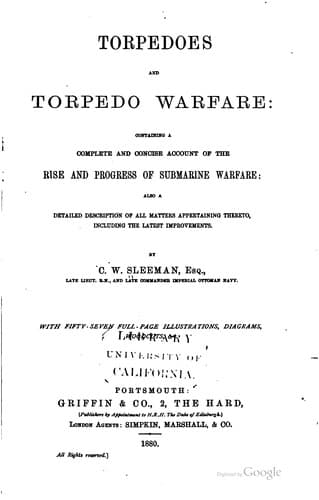
Torpedoes and Torpedo Warfare: Containing a Complete and Concise Account of the Rise and Progress of Submarine WarfareSleeman, Charles William
History
Torpedoes and Torpedo Warfare: Containing a Complete and Concise Account of the Rise and Progress of Submarine Warfare
Sleeman, Charles William
Torpedoes
In the instrument, at the firing point _a_ is a handle, by the turning
of which a step by step motion is given to the pointer of a dial _b_
and a simultaneous movement to the pointer _F_ of the instrument _C_
in the submerged box. When the handle _a_ has made a half turn it
couples one pole of the battery to the cable and the other to the earth
connection, and when it has made a complete turn the connections are
reversed. The pointer of the dial _b_ then moves forward from
one division of the dial to the next, and simultaneously the pointer
_F_ is turned in unison with it. The operator at the firing point can
therefore always see which of the torpedoes is in electrical connection
with the wire of the cable, and he can test each torpedo in succession
by moving a handle, say at _h_, to cause the current passing back from
the torpedo to pass through a galvanometer at _e_, and by the movement
of the needle of the galvanometer it can be seen whether the resistance
of the circuit through this torpedo is in its normal and proper working
state.
When the pointer of the dial _b_ is brought to zero, or as it is marked
in the drawing to "signal," then the pointer _F_ of the apparatus _C_
is in electrical communication with a contact point which is coupled to
all of the branch wires _D_, and usually the apparatus is left in this
condition, the handle _a_ being then locked and prevented from turning
by a bolt actuated by a handle at _G_.
The current from the battery at the firing point then passes to earth
through the resistances in all of the torpedoes. If now any one or
other of the torpedoes is struck by a passing vessel and the wire from
its fuze put directly to earth, so that the current passes freely to
earth instead of having first to pass through the resistance, the fact
of the current passing freely to earth is notified at the firing point
by the movement of the needle of a galvanometer _d_; the movement of
the needle of this galvanometer effects an electrical connection by
which a small battery is caused to sound a bell at _c_. The operator at
the firing point can then if he pleases at once fire the torpedo that
has been struck by moving a handle at _f_ and coupling up to the wire
of the cable a battery of greater strength; the strong firing current
will pass to earth through the fuze of the torpedo that has been
struck, and will ignite this fuze, but will not affect the fuzes of the
other torpedoes, as to pass through these fuzes it has also to pass
through resistances which impede its passage and reduce its strength,
so that the portion of the current which passes to earth through them
is not of sufficient strength to ignite the fuzes.
Public-domain text, read in full here on John Shaqi.
Reviews
Reviews
No reviews yet
Be the first to share your thoughts on this work.
Elsewhere in the archive
Join the Discussion
Join the discussion
Sign in to leave a comment or review.
Sign InorCreate an account