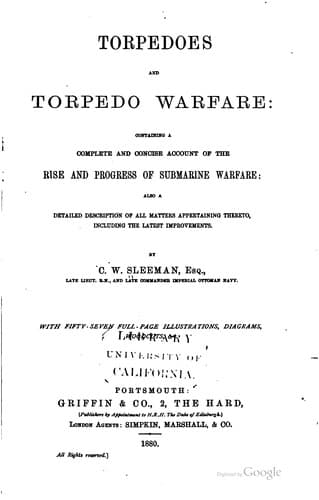
Torpedoes and Torpedo Warfare: Containing a Complete and Concise Account of the Rise and Progress of Submarine WarfareSleeman, Charles William
History
Torpedoes and Torpedo Warfare: Containing a Complete and Concise Account of the Rise and Progress of Submarine Warfare
Sleeman, Charles William
Torpedoes
_c._--It has the property of clinging to the metallic
conductor, by which is meant, that should it
(conductor) be cut through, and any strain be brought
on the cable, there is a tendency on the part of the
gutta percha to cling to the conducting wire, thereby
not increasing the fault.
The defects of such an insulator are:--
_a._--Its liability to become hard and brittle when
exposed to dry heat, and consequently it requires to be
stored under water.
_b._--It becomes comparatively a bad dielectric at 100°
F.
_c._--It becomes plastic at high temperatures, which
causes the conducting wire to alter its position.
In some particulars ordinary india rubber is a better insulator than
gutta percha, but this substance is equally inferior to Hooper's
material, &c. The advantages possessed by this substance are:--
_a._--It is not easily affected by a dry heat.
_b._--It is a very excellent dielectric.
The defects of this mode of insulation are:--
_a._--It must be put on the conducting wires in a
series of jointed pieces.
_b._--It does not cling to the conducting wire, so that
if the electric cable be cut, and any strain be brought
on it (cable), the previous fault is increased.
_c._--It absorbs 25 per cent. of water.
_Hooper's Material._--This insulating material consists of an inside
coating of pure india rubber, then another similar coating in
conjunction with oxide of zinc, which is termed the separator, and
an outside coating of india rubber combined with sulphur. The use of
the separator is to prevent any damage to the conducting wires by the
action of the sulphur. The three coatings are then baked for some
hours at a very high temperature, which fuses the whole into a solid
mass, and vulcanises the outer coating. The properties of the pure
india rubber which is in contact with the metallic conductor are thus
preserved, while any decay of the outer covering is prevented by the
vulcanising process.
The advantages claimed by Mr. Hooper for this mode of insulating
electric submarine cables, are:--
_a._--High insulation.
_b._--Flexibility.
_c._--Capability of withstanding the bad effects of dry
heat.
The qualifications essential to a perfect insulated electrical cable
for use with submarine mines are as follows:--
1.--Capacity to bear a certain amount of strain without
breaking.
2.--Perfect insulation, or at least as nearly so as
it is possible to obtain, and composed of a substance
capable of being readily stored, and kept for a
considerable length of time without being injured.
3.--Pliability so that it may be wound on, or paid out
from, a moderately sized drum without injury.
4.--Provided with an external covering capable of
protecting the dielectric from injury when used in
situations where there is a rocky or shingly bottom, &c.
Public-domain text, read in full here on John Shaqi.
Reviews
Reviews
No reviews yet
Be the first to share your thoughts on this work.
Join the Discussion
Join the discussion
Sign in to leave a comment or review.
Sign InorCreate an account