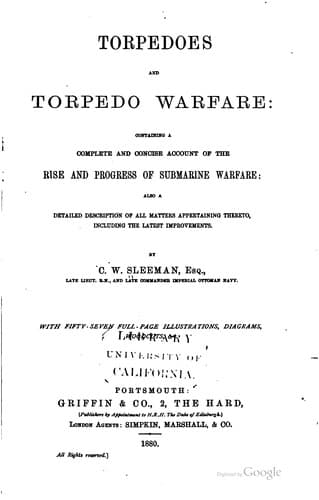
Torpedoes and Torpedo Warfare: Containing a Complete and Concise Account of the Rise and Progress of Submarine WarfareSleeman, Charles William
History
Torpedoes and Torpedo Warfare: Containing a Complete and Concise Account of the Rise and Progress of Submarine Warfare
Sleeman, Charles William
Torpedoes
So successful was this first attempt, and so tremendous was the effect
produced on the spectators, by the explosion of one of these torpedoes,
that further investigation of this new mode of Naval warfare was at
once instituted.
But it was not until some two hundred years after that any real
progress was effected, though numerous attempts were made during this
period, to destroy vessels by means of sub-marine infernal machines.
It was owing to the fact, that the condition which is now considered as
essential in torpedo warfare, viz., that the charge must be submerged,
was then entirely ignored, that so long a standstill occurred in this
new art of making war.
_Captain Bushnell, the Inventor of Torpedoes._--To Captain David
Bushnell, of Connecticut, in 1775, is most certainly due the credit
of inventing torpedoes, or as he termed them submarine magazines. For
he first proved practically that a charge of gunpowder could be fired
under water, which is incontestably the essence of submarine warfare.
_Submarine Boat._--To Captain Bushnell is also due the credit of first
devizing a submarine boat for the purpose of conveying his magazines to
the bottom of hostile ships and there exploding them.
_Drifting Torpedoes._--Another plan of his for destroying vessels, was
that of connecting two of his infernal machines together by means of a
line, and throwing them into the water, allowing the current to carry
them across the bows of the attacked ship.
_Mode of Ignition._--The ignition of his magazines was generally
effected by means of clockwork, which, when set in motion, would
run for some time before exploding the machines, thus enabling the
operators to get clear of the explosion.
Captain Bushnell's few attempts to destroy our ships off the American
coast in 1776 and 1777, with his submarine boat, and his drifting
torpedoes were all attended with failure, a result generally
experienced, where new inventions are for the first time subjected to
the test of actual service.
_Robert Fulton._--Robert Fulton, an American, following in his
footsteps, some twenty years after, revived the subject of submarine
warfare, which during that interval seems to have been entirely
forgotten.
A resident in France, in 1797, he is found during that year making
various experiments on the Seine with a machine which he had
constructed, and by which he designed "to impart to carcasses of
gunpowder a progressive motion under water, to a certain point, and
there explode them."[A]
_Fulton's Failures._--Though these first essays of his resulted in
failure, Fulton thoroughly believed in the efficacy of his schemes, and
we find him, during that and succeeding years, vainly importunating the
French and Dutch Governments, to grant him aid and support in carrying
out experiments with his new inventions, whereby he might perfect
them, and thus ensure to whichever government acceded to his views, the
total destruction of their enemy's fleets.
Public-domain text, read in full here on John Shaqi.
Reviews
Reviews
No reviews yet
Be the first to share your thoughts on this work.
Join the Discussion
Join the discussion
Sign in to leave a comment or review.
Sign InorCreate an account