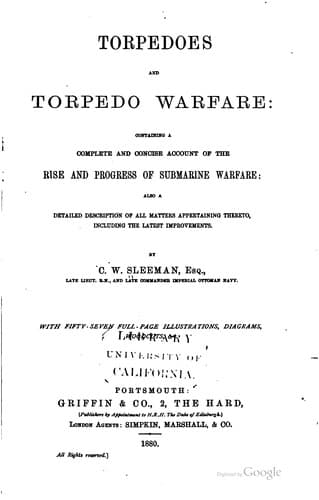
Torpedoes and Torpedo Warfare: Containing a Complete and Concise Account of the Rise and Progress of Submarine WarfareSleeman, Charles William
History
Torpedoes and Torpedo Warfare: Containing a Complete and Concise Account of the Rise and Progress of Submarine Warfare
Sleeman, Charles William
Torpedoes
1.--Thomson's electrometer.
2.--Thomson's reflecting galvanometer.
3.--Astatic galvanometer.
4.--Differential galvanometer.
5.--Detector galvanometer.
6.--Three coil galvanometer.
7.--Thermo galvanometer.
8.--Siemens's universal galvanometer.
9.--A shunt.
10.--Commutator.
11.--Rheostat.
12.--Resistance coils.
13.--Wheatstone's balance.
Electrometers indicate the presence of a statical charge of
electricity, by showing the force of attraction or repulsion between
two conducting bodies placed near together. This force depending in the
first place on the quantity of electricity with which the conducting
bodies are charged, ultimately depends on the difference of potential
between them; an electrometer is therefore strictly an instrument for
measuring difference of potential.[J]
Sir William Thomson's quadrant electrometer is the most perfect form
of electrometer yet constructed, and the one usually employed in cable
testing. It consists of a very thin flat aluminium needle spread out
into two wings, and hung by a wire from an insulated stem inside a
Leyden jar, which contains a cupful of strong sulphuric acid, the outer
surface of which forms the inner coating of the Leyden jar. A wire
stretched by a weight connects the aforesaid needle with this inner
coating. A mirror, rigidly attached to this needle by a rod, serves
to indicate the deflection of the needle by reflecting the image of
a flame on to a scale. The needle hangs inside four quadrants, which
are insulated by glass stems: each pair of opposite quadrants are in
electrical connection. Above and below the quadrants two tubes, at
the same potential as the needle, serve to screen it and the wires in
connection with it from all induction except that produced by the four
quadrants. Suppose the needle charged to a high negative potential (-),
then if the quadrants are symmetrically placed, it will deflect neither
to the right nor to the left, so long as the near quadrants are at the
same potential. If one of these be positive relatively to the other,
the end of the needle under them will be repelled from the negative
quadrant to the positive one, and at the same time the other end of the
needle will be repelled from in the opposite direction. This motion
will be indicated by the motion of the spot of light reflected by the
mirror, and the number of divisions which the spot of light traverses
on the scale measures in an arbitrary unit the difference of potential
between the + and - quadrants.
The reflecting electrometer being a very delicate instrument, requires
careful handling, and should only be used by a practised electrician.
Its use would therefore be restricted to important stations, and
special tests of a delicate nature.
_Thomson's Reflecting Galvanometer._--A galvanometer is an instrument
intended to detect the presence of a current and measure its magnitude.
Public-domain text, read in full here on John Shaqi.
Reviews
Reviews
No reviews yet
Be the first to share your thoughts on this work.
Elsewhere in the archive
Join the Discussion
Join the discussion
Sign in to leave a comment or review.
Sign InorCreate an account