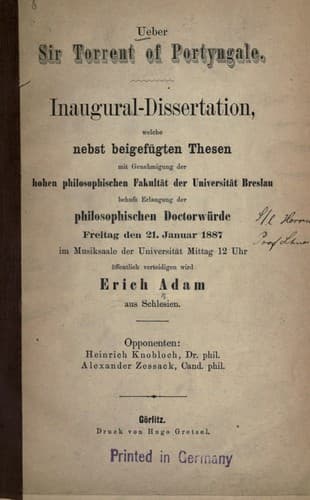
Knights and knighthood -- Poetry; Romances, English
The carefull lady then was blythe,
To the londe she went full swythe,
As fast as she myght. 1857
Tyll the day began to sprynge,
Foules on trees merely gan synge
Delicyous notes on hyght. 1860
To a hyll went that lady fre,
Where she was ware of a cyte
With toures fayre and bryght. 1863
Therof I-wys she was fayne,
She set hir downe, as I herd sayne,
Hir chyldren for to dyght. 1866
NOTES.
PAGE 1, line 12. Cf. ll. 118, 187, 190, 198, 558, 924, 1924, 2183. So in
_Eglamour_ (Thornton Romances), l. 408:
‘The boke of Rome thus can telle,’
and _The Erl of Tolouse_, ed. Lüdtke, l. 1219:
‘Yn Rome thys geste cronyculyd ys.’
See Halliwell’s and Lüdtke’s notes to these passages. I agree with both
of them, that an expression like that does not earnestly refer the
reader to a Latin or Italian source of the story; there is evidently no
difference at all between _in Rome_ and _in romance_.
p. 1, l. 15. _wyght_ has been inserted instead of _dowghtty_ in order to
restore the rhyme with _hyght_, _knyght_, _myght_; cf. _Havelok_, ed.
Skeat, l. 344:
‘He was fayr man and wicth.’
p. 1, l. 17 = _Ipomadon_, l. 63. Parallel passages to this hyperbolic
expression are collected in Kölbing’s note to this line (p. 364).
p. 1, l. 24. We find the same idea as here, viz. that nobody can resist
the will of God, who has power over death and life, in _Sir Tristrem_,
ll. 236 ff.:
‘Þat leuedi, nouȝt to lain,
For soþe ded is sche!
Who may be ogain?
As god wil, it schal be,
Vnbliþe.’
p. 2, l. 28. I have not met with the verb _fesomnen_ anywhere else, and
it is not mentioned in Stratmann and Mätzner. Halliwell, Dictionary,
p. 354, explains it by ‘feoffed, gave in fee,’ doubtless regarding this
very passage, although he doesn’t cite it; might _fesomnyd_ not be a
corruption from _sesyd_? cf. _Havelok_, ll. 250 f.:
‘Þat he ne dede al Engelond
Sone sayse intil his hond.’
Hall writes to me on this word as follows: _fesomnyd_ is, I am
convinced, not a word at all, but a scribe’s error for _festonyd_ or
_festnyd_ = confirmed, fixed. Comp. ’_And þat ich hym wolde myd trewþe
siker faste on honde_,’ Robert of Gloucester (Hearne), p. 150. For this
use of _fasten, fastnen_, comp. ’_But my forwarde with þe I festen on
þis wyse_,’ Alliterative Poems, p. 47, l. 327: ’_& folden fayth to þat
fre, festned so harde_,’ Sir Gawayne, p. 57, l. 1783: ’_And þis forward,
in faith, I festyn with hond_,’ Destruction of Troy, p. 22, l. 636. See
also Jamieson’s Scottish Dictionary, ii. p. 216, under _to Fest_.
p. 2, l. 30. I am by no means sure that _fede_ is the original reading,
but I wasn’t able to find a better word rhyming with _dedde_, _wede_;
even the _ne._ ‘feed’ means _pasture_, and that is what we expect here.
p. 2, l. 31. For my correction cf. Lüdtke’s note to _The Erl of
Tolouse_, l. 199, sub 2; _Eglam._, l. 26:
Public-domain text, read in full here on John Shaqi.
Reviews
Reviews
No reviews yet
Be the first to share your thoughts on this work.
Elsewhere in the archive
Join the Discussion
Join the discussion
Sign in to leave a comment or review.
Sign InorCreate an account