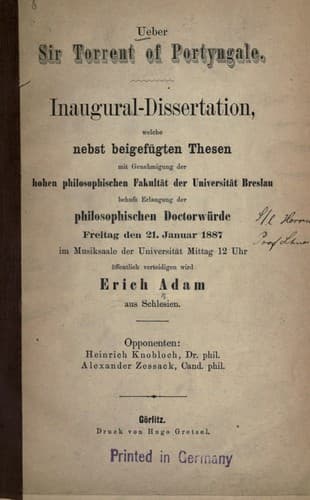
Knights and knighthood -- Poetry; Romances, English
‘That was a maydyn as whyte as fome,’
_Ib._ l. 683:
‘Crystyabelle as whyte as fome,’
where the _Percy Folio MS._ reads:
‘Christabell that was as faire as sunn;’
_Chronicle of England_, l. 75 f.:
‘Ant nomeliche to thy lemmon,
That ys wyttore then the fom.’
p. 2, l. 50. The alteration of _And_ and _bee_ into _An_ and _see_
seemed necessary; _sayment_ is like Fr. _essaiement_, Lat.
_exagimentum_.
p. 3, l. 59. Cf. l. 1216 f. and _The Lyfe of Ipomydon_, ed. Kölbing,
l. 1795:
‘If thou hyr haue, thou shalt hyr bye.’
p. 3, l. 77 f. As half of the stanza is lost, it is impossible to make
out to whom _they_ refers. Nor do I believe that l. 78 is correct,
especially as to _chaunce_.
p. 3, l. 79. Cf. _Ipomadon_, ed. Kölbing, l. 8123:
‘A myle wyth in the Grekes see.’
p. 3, l. 80. _in an yle_ is certainly the correct reading; _mauyle_ was
introduced by a scribe who supposed it to be the giant’s name; but that
is mentioned some twenty lines later.
p. 5, l. 136. The correction of _lyght_ into _ryght_ I owe to Hall, who
refers me to the legend of _Sancta Maria Egyptiaca_; cf. f. i. Barbour’s
_Legends of Saints_, ed. Horstmann, I. p. 143 ff.
p. 6, l. 153. _nowyd_ = ‘anoyed’ gives a poor sense. Hall suggests
_nowtyd_; cf. E. D. S., No. 6, Ray’s _North Country Words_, p. 59,
_note_, to push, strike or soar, with the horn, as a bull or ram,’ ab.
A.S. _huitan_, ejusdem significationis. The word might then mean
‘spurred.’
p. 6, l. 171 = l. 596. This alliterative binding is a very frequent one;
cf. _Sir Orfeo_, ed. Zielke, p. 9.
p. 7, l. 188. The same rhyme, which I have restored here, occurs
l. 559 f.
p. 7, l. 190. _Yt tellythe_ = _Yt is told_; cf. Lüdtke, note to _The Erl
of Tolouse_, l. 1070, and Sarrazin, note to _Octavian_, l. 1749.
p. 9, l. 236. I was about to write, _Crystyn men thow they were_,
referring this line to the guardians of the lions; but, no doubt, Hall’s
reconstruction of the line, which I have put into the text, is far
better.
p. 9, l. 237. _Hys browys wexe bla_, i.e. he turned pale, he was struck
with fear; cf. _bloo askes_, P. Pl., l. 1553, and the German _aschfahl_.
Quite a similar expression occurs in _Perceval_, l. 687 f.:
‘Now sone of that salle wee see,
Whose browes schalle blakke.’
_Ib._ l. 1056:
‘His browes to blake.’
p. 9, l. 245. Though _syghyng_ gives no offence, still it may be, that
the author has written _syngyng_, and the scribe was wrong in altering
it; cf. Zupitza’s note to _Guy_, l. 5424.
p. 9, l. 251. Cf. l. 802, 1204, _Ipomadon_, l. 6481 f.:
‘Your nece of Calabyre, that lady clere,
Ys bovnden wyth a fendes fere.’
_Reliquiæ Antiquæ_, i. p. 241:
‘He seith bi niȝte and eke bi day,
That hy beth fendes ifere.’
p. 10, l. 265 f. The reading of these two lines is quite destroyed by
the careless scribe. My correction is not more than an attempt to
restore the rhyme.
Public-domain text, read in full here on John Shaqi.
Reviews
Reviews
No reviews yet
Be the first to share your thoughts on this work.
Elsewhere in the archive
Join the Discussion
Join the discussion
Sign in to leave a comment or review.
Sign InorCreate an account