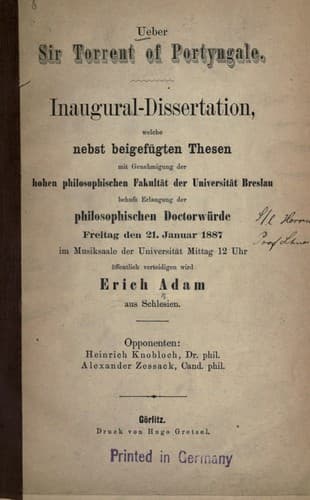
Knights and knighthood -- Poetry; Romances, English
p. 23, l. 640. On the meaning of _theff_, cf. Kölbing’s note to _Am. and
Amil._, l. 787.
p. 24, l. 659. _of Perowne_ is certainly wrong, as it does not agree
with the rhymes _stere_, _nere_, _fere_; but I don’t know how to amend
the line.
p. 24, l. 662. _schere_ gives no meaning; I write _stere_ and translate,
There might nobody move further, _i.e._ the giant was brought to a
standstill in the glen.
p. 24, l. 665. Cf. ll. 434, 791.
p. 25, l. 688. Cf. _Eglam._, l. 324:
‘And to [the] herte hym bare.’
The weak preterit tense of _berien_ is very rare; if _bere_ = A.S.
_beran_ sometimes has the same meaning, _i.e._ ‘to strike,’ the reason
is that A.S. _beran_ and Icel. _berja_ are confounded.
p. 25, l. 696. _woo_ can hardly stand for _wood_. It seems to me like a
last corruption of an old romance phrase, like _worthy inwith wall
(woȝe)_; possibly the line was simply so: _Thus in II journeys Torrent
so_.--Hall.
p. 25, l. 700. On the use of M.E. _fote_ as a plural see Zupitza’s note
to _Guy_, l. 598.
p. 26, l. 722. Hall suggests, the original phrase may have been: _pomely
whyt and grey_; cf. Chaucer, _C. T._, Prol., l. 615 f.:
‘This reeve sat vpon a ful good stot,
That was al {pomely gray}, and highte Scot.’
p. 27, l. 744. Cf. l. 788. On _St. James_ cf. Kölbing’s note to _Am. and
Amil._, l. 796.
p. 29, l. 808 f. ‘In so dangerous conditions he has been before [and
still come back safe], so he will come back even this time.’
p. 29, l. 819. On the meaning of the phrase ’_the bord beginne_,’ cf.
Kölbing, _Englische studien_, III. p. 104, and Zupitza, _Anglia_, III.
p. 370 f.
p. 30, l. 838. This stanza being incomplete, I think, the lacuna is to
be put after l. 838. The missing three lines contained the fact, that
the king promises Torrent, before his knights, that, when he has done
this deed, he will give him his daughter, and grant him one half of his
kingdom during his life, and the whole afterwards; cf. l. 1206 ff. The
odd number of XXVII knights is probably due only to the scribe; cf. F.
III: _By VII score of hardy knyghtes_.
p. 31, l. 867 f. These two lines are poor, and the rhyme is very bad;
l. 868 may have run originally, _Thurrow Pervyns, for sothe, it ley_;
cf. l. 949.
p. 32, l. 901. _squyere_, although very odd at the first sight, may
still be right; Torrent says: ‘The only squier that I took with me for
this journey, is my sword’; cf. l. 909.
p. 33, l. 922. Cf. Kölbing’s note to _Ipomadon_, l. 3344.
p. 33, l. 924-6. On the story of a child, begotten by a devil on a
sleeping woman, cf. Breul, _Sir Gowther_, p. 119 f.
p. 34, l. 954 ff. Cf. _Tristrem_, l. 1409 ff.:
‘Out of Deuelin toun
Þe folk wel fast ran,
In a water to droun,
So ferd were þai þan.’
p. 34, l. 963 f. Cf. _Beves of Hamtoun_, l. 187 f.:
‘Madame, a seide, for loue myn,
Whar mai ich finde þat wilde swin?’
p. 36, l. 1000. Instead of _spere_ perhaps we ought to read _sworde_.
Public-domain text, read in full here on John Shaqi.
Reviews
Reviews
No reviews yet
Be the first to share your thoughts on this work.
Elsewhere in the archive
Join the Discussion
Join the discussion
Sign in to leave a comment or review.
Sign InorCreate an account