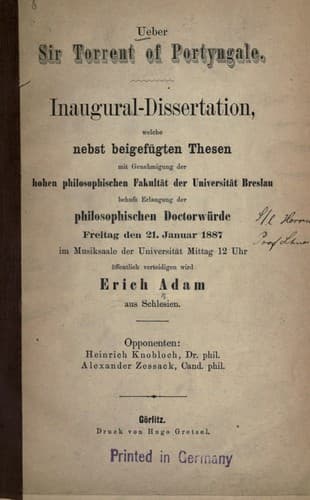
Knights and knighthood -- Poetry; Romances, English
p. 56, l. 1600. That _dynt_ is wrong, the rhyme shows as well as the
meaning. But whether my alteration is right, seems very doubtful,
especially as l. 1609 offers the same rhyming word.
p. 58, st. 142. Rhymes like _dight_, _be-taught_, _draught_, _right_ can
by no means be admitted. Now, instead of _be-taught_ we may be allowed
to write _be-teighte_ (cf. _Beket_, l. 1827), and l. 1654 may have run:
‘He wold haue a draught, aplight.’
p. 59, l. 1676. After _was_, _sent_ may have been dropped.
p. 59, l. 1692. _For his love_, i.e. ‘As his sweetheart.’
p. 60, l. 1714. Cf. _Ipomadon_, l. 52:
‘Begge he wex of bonne and blode.’
_Ib._ l. 1763:
‘Ryghtte bygge of bone and blode.’
p. 60, l. 1722: ‘All his men agreed with him,’ viz. that this was the
knight whom he came to seek.
p. 62, l. 1774. Is _her day_ = A.S. _aerdagas_, cf. _Havelok_, l. 27?
The word is very rare, and in this meaning occurs only in the plural.
p. 62, l. 1777. After _king_, _on kne_ may have dropped out.
p. 63, l. 1799. Cf. Chaucer, _C. T._, the Millere’s Tale, l. 325:
‘Say what thou wolt, I schal it never telle
To child no wyf, by him that harwed helle.’
_Ib._, The Sompnoure’s Tale, l. 407:
‘Now help, Thomas, for him that harewed helle.’
Perhaps even here, l. 1702, _Iesu, that made hell_, ought to be altered
into _I. that harowde hell_.
p. 64, l. 1846. Perhaps we ought to read _ebbyng_ instead of _eb_,
according to l. 223; one can hardly say, that ‘the sea is eb.’
p. 68, l. 1961. Instead of _A_ I should prefer to read _The_, because
this griffon is the same which robbed the child before.
p. 69, l. 1982. _Of what lond that he is left_, i.e. ‘Wherever he may be
born.’
p. 69, l. 1991 f. Cf. _Ipomadon_, l. 50 f.:
‘He sayd: Fro tyme he kepe tham con,
My landes I shall hym take.’
p. 70, l. 2002. _It is good in euery fight_, i.e. there is a stone in
the ring which heals wounds, if they are touched with it; cf. Kölbing’s
note to _Ipomadon_, l. 8018.
p. 70, l. 2010. Halliwell, p. 306, explains _disparlid_ by ‘beaten down,
destroyed,’ a meaning which is not fit for this passage. I read with a
slight addition _disparplid_ = ‘dispersed,’ a rare word; cf.
_Stratmann_, p. 156.
p. 71, l. 2026. _But_ is probably to be altered into _And_.
p. 72, l. 2053. Cf. Kölbing’s note to _Tristrem_, l. 3068.
p. 72, l. 2075. One might be inclined to write:
‘That my two children vncrystonyd ware,’
but I don’t think that we are obliged to change: ‘I cared only for that
one thing, That my two children might be christened.’
p. 74, l. 2126. For _hing_ instead of _heng_ cf. Mätzner,
_Sprachproben_, I. 1, p. 292, note to line 675, where _hynges_ rhymes
with _springes_.
p. 74, l. 2135. _hede vale_, i.e. principal, best choice; _vale_ =
_wale_, or perhaps aphetic for _avale_ = value.--HALL.
p. 74, l. 2138. _born_ seems to me somewhat suspicious, though I cannot
propose a better reading; _and torn_ instead of _born_ wouldn’t do.
Public-domain text, read in full here on John Shaqi.
Reviews
Reviews
No reviews yet
Be the first to share your thoughts on this work.
Elsewhere in the archive
Join the Discussion
Join the discussion
Sign in to leave a comment or review.
Sign InorCreate an account