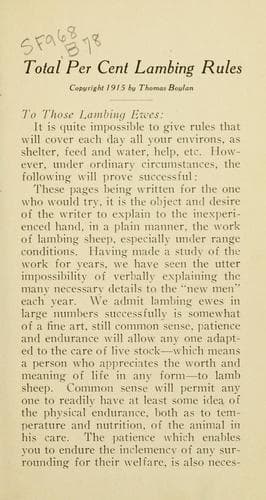
Put the best man you have with your dropping ewes. He should have a
cool temper, good feet, and the will to use them. Each day he should
have a sheep crook and some quarter-inch rope with him. The sheep should
have salt or salt feed enough to be contented. Water them once a day
during dry weather; on rainy days they will feed better when not given
water. In bunch lambing, where the new-born lambs are with the dropping
ewes all the time, 700 ewes are enough to the band, while if you lamb by
the dropping system, where you part the new-born lambs and their mothers
from the dropping ewes several times each 24 hours, you may have up to
4,000 ewes in the drop band. This is not advisable where your range is
closed in or short on feed or water. Upon such a range 1,500 ewes are
enough to the band. Have them bedded in the warmest places at night. In
nice weather let them leave the bed ground as early as possible, while
in bad weather--if you have them on a good bed ground--let them remain
as long as they wish. Never hold them on the bed ground in the morning
by rushing them back with a dog when they are ready to leave. By so
mixing the ewes you will "bum" lambs dropped during the night. On bad
days put them in the warmest places, behind hills, in high brush, or any
other good shelter you may have near at hand, which will keep the
new-born lambs out of the wind. During warm and pleasant days let them
out well in the morning hours, then hold them up a few hours on good
feed, turning them toward camp and water early in the afternoon, so that
the lambs dropped in the evening hours will be near camp, where they
will not have to be moved.
Should your range allow you to change the bed ground each night, while
the lambs are coming fast, it is best to do so. When the range is so
situated that you cannot move camp each day, compelling you to move the
ewes with lambs off the bed ground, so the dropping ewes may bed in the
same place again, try not to move them until about the time the droppers
come in around camp in the evening, say about 4 p. m. Do not move them
farther than is necessary to keep them from mixing with the drop band
during the night. Before the ewes bed down for the night, catch all ewes
that appear sick and have not been on feed or wish to be alone, not
caring to follow the herd longer. Such ewes likely have a dead lamb in
them. Watch for such ewes during the day and take the lamb from them
before blood poison kills the ewe. Safeguard yourself and the ewe, if
convenient, by disinfecting your hands before and after doing this.
WORKING THE BED GROUND.
Public-domain text, read in full here on John Shaqi.
Reviews
Reviews
No reviews yet
Be the first to share your thoughts on this work.
Join the Discussion
Join the discussion
Sign in to leave a comment or review.
Sign InorCreate an account