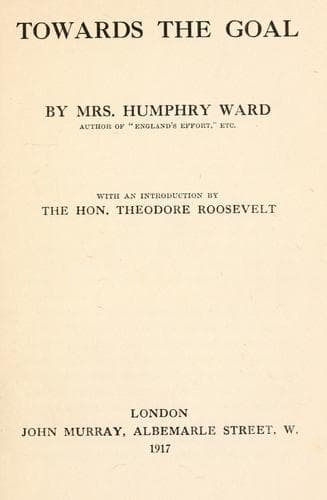
World War, 1914-1918 -- Campaigns -- Western Front; World War, 1914-1918 -- Personal narratives
We were to start early and motor far, but there was time before we
started for a little talk with Mademoiselle. She was full of praise for
our English soldiers, some of whom were billeted in the village. "They
are very kind to our people, they often help the women, and they never
complain." (Has the British Tommy in these parts really forgotten how to
grouse?) "I had some of your men billeted here. I could only give them a
room without beds, just the bare boards. 'You will find it hard,' I
said. 'We will get a little straw,' said the sergeant. 'That will be all
right.' Our men would have grumbled." (But I think this was
Mademoiselle's _politesse_!) "And the children are devoted to your
soldiers. I have a dear little girl in the school, nine years old.
Sometimes from the window she sees a man in the street, a soldier who
lodges with her mother. Then I cannot hold her. She is like a wild thing
to be gone. 'Voilà mon camarade!--voilà mon camarade!' Out she goes, and
is soon walking gravely beside him, hand in hand, looking up at him."
"How do they understand each other?" "I don't know. But they have a
language. Your sergeants often know more French than your officers,
because they have to do the billeting and the talking to our people."
The morning was still bright when the motor arrived, but the frost had
been keen, and the air on the uplands was biting. We speed first across
a famous battlefield, where French and English bones lie mingled below
the quiet grass, and then turn south-east. Nobody on the roads. The
lines of poplar-trees fly past, the magpies flutter from the woods, and
one might almost forget the war. Suddenly, a railway line, a steep
descent and we are full in its midst again. On our left an encampment of
Nissen huts--so called from their inventor, a Canadian officer--those
new and ingenious devices for housing troops, or labour battalions, or
coloured workers, at an astonishing saving both of time and material. In
shape like the old-fashioned beehive, each hut can be put up by four or
six men in a few hours. Everything is, of course, standardised, and the
wood which lines their corrugated iron is put together in the simplest
and quickest ways, ways easily suggested, no doubt, to the Canadian
mind, familiar with "shacks" and lumber camps. We shall come across them
everywhere along the front. But on this first occasion my attention is
soon distracted from them, for as we turn a corner beyond the hut
settlement, which I am told is that of a machine-gun detachment, there
is an exclamation from D----.
Public-domain text, read in full here on John Shaqi.
Reviews
Reviews
No reviews yet
Be the first to share your thoughts on this work.
Join the Discussion
Join the discussion
Sign in to leave a comment or review.
Sign InorCreate an account