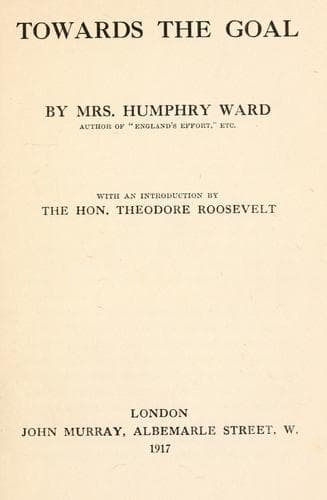
World War, 1914-1918 -- Campaigns -- Western Front; World War, 1914-1918 -- Personal narratives
"It is a curious thing to walk over enemy trenches that I have watched
like a tiger for weeks and weeks. But what of the boys who took those
trenches, with their eleven rows of barbed wire in front of them? I
don't think I ever before to-day rated the British soldier at his proper
value. His sufferings in this weather are indescribable. When he is not
in the trenches his discomforts are enough to kill any ordinary mortal.
When he is in the trenches it is a mixture between the North Pole and
Hell. And yet when the moment comes he jumps up and charges at the
impossible--and conquers it! ... Some of the poor fellows who lay there
as they fell looked to me absolutely noble, and I thought of their
families who were aching for news of them and hoping against hope that
they would not be left unburied in their misery.
"All the loving and tender thoughts that are lavished on them are not
enough. There are no words to describe the large hearts of these men.
God bless 'em! And what of the French on whose soil they lie? Can they
ever forget the blood that is mingled with their own? I hope not. I
don't think England has ever had as much cause to be proud as she
has to-day."
Ah! such thoughts and feelings cut deep. They would be unbearable but
for the saving salt of humour in which this whole great gathering of
men, so to speak, moves suspended, as though in an atmosphere. It is
everywhere. Coarse or refined, it is the universal protection, whether
from the minor discomforts or the more frightful risks of war. Volumes
could be filled, have already been filled, with it--volumes to which
your American soldier when he gets to France in his thousands will add
considerably--pages all his own! I take this touch in passing from a
recent letter:
"A sergeant in my company [writes a young officer] was the other day
buried by a shell. He was dug out with difficulty. As he lay, not
seriously injured, but sputtering and choking, against the wall of the
trench, his C.O. came by. 'Well, So-and-so, awfully sorry! Can I do
anything for you?' 'Sir,' said the sergeant with dignity, still
struggling out of the mud, '_I want a separate peace_!'"
And here is another incident that has just come across me. Whether it is
Humour or Pathos I do not know. In this scene they are pretty close
together--the great Sisters!
A young flying officer, in a night attack, was hit by a shrapnel bullet
from below. He thought it had struck his leg, but was so absorbed in
dropping his bombs and bringing down his machine safely that, although
he was aware of a feeling of faintness, he thought no more of it till he
had landed in the aerodrome. Then it was discovered that his leg had
been shot away, was literally hanging by a shred of skin, and how he had
escaped bleeding to death nobody could quite understand. As it was, he
had dropped his bombs, and he insisted on making his report in hospital.
Public-domain text, read in full here on John Shaqi.
Reviews
Reviews
No reviews yet
Be the first to share your thoughts on this work.
Join the Discussion
Join the discussion
Sign in to leave a comment or review.
Sign InorCreate an account