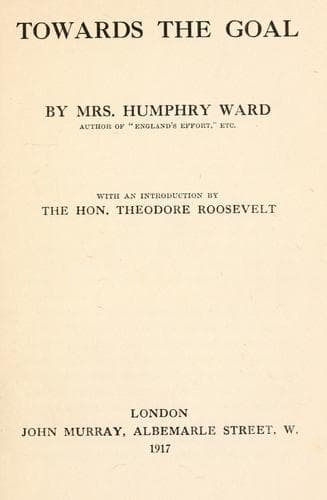
World War, 1914-1918 -- Campaigns -- Western Front; World War, 1914-1918 -- Personal narratives
"You would like to hear the story of the German occupation?" He thought
a little before beginning, and I was struck with his strong, tired face,
the powerful mouth and jaw, and above them, eyes which seemed to have
lost the power of smiling, though I guessed them to be naturally full of
a pleasant shrewdness, of what the French call _malice_, which is not
the English "malice." He was rather difficult to follow here and there,
but from his spoken words and from a written account he placed in my
hands, I put together the following story:
"It was August 30th, 1914, when the British General Staff arrived in
Senlis. That same evening, they left it for Dammartin. All day, and the
next two days, French and English troops passed through the town. What
was happening? Would there be no fighting in defence of Paris--only
thirty miles away? Wednesday, September 2nd--that was the day the guns
began, our guns and theirs, to the north of Senlis. But, in the course
of that day, we knew finally there would be no battle between us and
Paris. The French troops were going--the English were going. They left
us--marching eastward. Our hearts were very sore as we saw them go.
"Two o'clock on Wednesday--the first shell struck the cathedral. I had
just been to the top of the belfry to see, if I could, from what
direction the enemy was coming. The bombardment lasted an hour and a
half. At four o'clock they entered. If you had seen them!"
The old Curé raised himself on his seat, trying to imitate the insolent
bearing of the German cavalry as they led the way through the old town
which they imagined would be the last stage on their way to Paris.
"They came in, shouting '_Paris_--_Nach Paris!'_ maddened with
excitement. They were all singing--they were like men beside
themselves."
"What did they sing, Monsieur le Curé?--Deutschland über alles'?"
"Oh, no, madame, not at all. They sang hymns. It was an extraordinary
sight. They seemed possessed. They were certain that in a few hours they
would be in Paris. They passed through the town, and then, just south of
the town, they stopped. Our people show the place. It was the nearest
they ever got to Paris.
"Presently, an officer, with an escort, a general apparently, rode
through the town, pulled up at the Hôtel de Ville, and asked for the
Maire--angrily, like a man in a passion. But the Maire--M. Odent--was
there, waiting, on the steps of the Hôtel de Ville.
"Monsieur Odent was my friend--he gave me his confidence. He had
resisted his nomination as Mayor as long as he could, and accepted it
only as an imperative duty. He was an employer, whom his workmen loved.
One of them used to say--'When one gets into M. Odent's employ, one
lives and dies there.' Just before the invasion, he took his family
away. Then he came back, with the presentiment of disaster. He said to
me--'I persuaded my wife to go. It was hard. We are much attached to
each other--but now I am free, ready for all that may come.'
Public-domain text, read in full here on John Shaqi.
Reviews
Reviews
No reviews yet
Be the first to share your thoughts on this work.
Join the Discussion
Join the discussion
Sign in to leave a comment or review.
Sign InorCreate an account