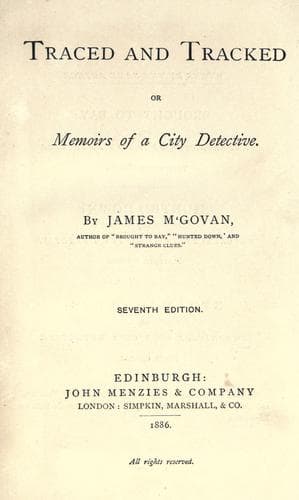
Traced and Tracked; Or, Memoirs of a City DetectiveM'Govan, James
General
Traced and Tracked; Or, Memoirs of a City Detective
M'Govan, James
Detective and mystery stories; Edinburgh (Scotland) -- Fiction
Coglin resolved to be his own avenger as before, and went to
Portobello to see his son. He affected to believe Bob’s story of
being poisoned by the pennyworth of gingerbread, and reminded him
of how often he had warned him against eating anything that was
not baked at home. Bob was delighted to get off so easily, and
humbly promised to remember the advice, which he did by never again
putting a cake baked by his father within his lips. When the boys
were brought home, and the unhappy seller of the gingerbread had
been liberated, with his raven locks turned grey with terror of the
scaffold, Coglin was at liberty to punish the criminal. This time
he resolved to make his vengeance sweeping in its character, and to
confide the execution of it to no one but himself. To decide on the
special punishment required a deal of thinking, but all Coglin’s
thinking pointed to one qualification—the retaliation must include
personal loss to Burfoot. Coglin had already lost considerably by
Burfoot’s crime; it was but just that Burfoot should suffer in the
same manner. While Coglin was at a loss to decide the matter, the
newspapers or public press kindly came to his aid. In these he saw
described a case of fire-raising by wandering tinkers, who had made
up a pellet of chemicals, procurable at any drysalter’s, which, on
being thrown down among straw or wood, spontaneously ignited, and
burned so fiercely that the whole place was speedily in a blaze.
Coglin for nights on end devoted himself to amateur chemistry, and
with such ardour that he at length produced a pellet, quite good
enough to set the whole of Burfoot’s donkey-shed and pig-styes in
flames. The pellet, when finished, resembled a lump of badly-dried
clay; and to ensure its safety, Coglin, when it was finished, placed
it in one of his metal confection pans, and locking it in his
bakehouse, went to survey his foe’s premises and decide upon the best
spot for throwing the pellet. He succeeded to perfection. There was
easy access to the place, a convenient window to the shed, plenty
of straw inside, and the whole of the sheds were of wood as dry
as tinder, and promising a grand blaze. It gave Coglin additional
satisfaction to know that Burfoot’s place was not insured. While
the baker was thus settling matters at the other end of the town, a
curious incident was taking place on his own premises. His shop and
house were in the front street, and the bakehouse in a lane at the
back. While Coglin was gone, his wife attended to the shop, and while
doing so was asked by a customer for a little barm. To get that she
had to take down the key of the bakehouse from its accustomed nail,
and go down to the place herself, while the customer waited in the
shop. She was not long gone, but woman’s curiosity in that short time
had induced her to peep into the closed pot. Finding only a dirty
piece of clay inside she examined it closely, and then tossed it into
a corner among some chopped wood there stacked, and then hurried off
Public-domain text, read in full here on John Shaqi.
Reviews
Reviews
No reviews yet
Be the first to share your thoughts on this work.
Elsewhere in the archive
Join the Discussion
Join the discussion
Sign in to leave a comment or review.
Sign InorCreate an account