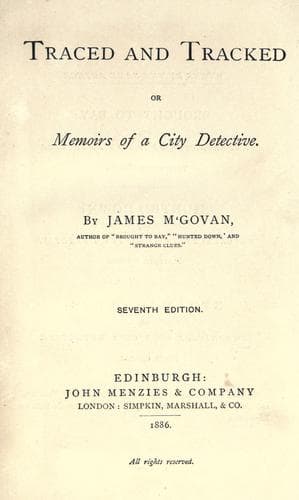
Traced and Tracked; Or, Memoirs of a City DetectiveM'Govan, James
General
Traced and Tracked; Or, Memoirs of a City Detective
M'Govan, James
Detective and mystery stories; Edinburgh (Scotland) -- Fiction
to her customer with the barm. They conversed earnestly for a time,
and then parted mutually pleased. When the barm-buyer had gone, a boy
ran into the shop with the startling message—
“Your bakehoose is bleezing!”
It was blazing, and had been for some time, as the infuriated tailor
above could testify. He had barely time to secure his kirkgoing suit
and his spectacles when the whole tenement was in a blaze. He swore
at the bakehouse and its owner as the ruin of him and his prospects.
His furniture and effects were all lost, and he did not hesitate to
hint that the whole had been done intentionally.
He was in the midst of these recriminations when Coglin appeared, and
stood speechless before the blazing house.
“You did it on purpose, because you kent I wasna insured, and because
you thought I went into your bakehouse and spoilt your batch,” cried
the distracted tailor, pouncing on the astonished baker and trying to
throttle him black in the face; “but I’ll hae the law to you, or I’ll
tak’ your life wi’ my ain hands.”
They fought madly for some moments, and were then, considerably
damaged, torn asunder by the bystanders. The tailor raved like a
madman, and, astonishing to all, the baker listened to his frenzied
accusations with the greatest meekness and calmness.
The truth is that the tailor, in his passion, had allowed several
words and expressions to escape him which for the first time made
Coglin doubt his own acumen in accusing Burfoot of the first outrage,
and ask himself at the same time if it was not possible that the real
perpetrator was Thomas Elder, tailor. The man had a strong hatred to
him, and they had quarrelled quite as bitterly as he and Burfoot.
The words and expressions would admit of no other explanation than
Elder’s guilt, and now several circumstances recurred to Coglin’s
memory to confirm the idea. The tailor had bought herrings on that
day, and witnessed the quarrel, and might easily have conceived the
plan of entering the bakehouse and smearing the window and board with
herring scales to convey the idea that the herring hawker was the
criminal.
While Coglin was slowly evolving these ideas, a hand was placed
on his arm, and, looking round, he found Burfoot at his side with
genuine concern and consternation on his face.
“I’m real sorry for this,” he said, wringing Coglin’s hand, “and if
the loan of thirty or forty pounds will help you in your strait, you
can depend upon me.”
“Good God! no!” cried Coglin, chokingly.
“But I say, yes. I can surely help a friend in distress,” persisted
Burfoot, warmly.
“A friend?” said Coglin, helplessly. “Yes.”
“And I’m almost glad to have the chance, for that tailor has lost
everything,” added Burfoot, in a whisper. “Nobody can be sorry for
him, for, between ourselves, I believe he was the man who entered
your bakehouse and spoiled your flour.”
“What?”
Public-domain text, read in full here on John Shaqi.
Reviews
Reviews
No reviews yet
Be the first to share your thoughts on this work.
Elsewhere in the archive
Join the Discussion
Join the discussion
Sign in to leave a comment or review.
Sign InorCreate an account