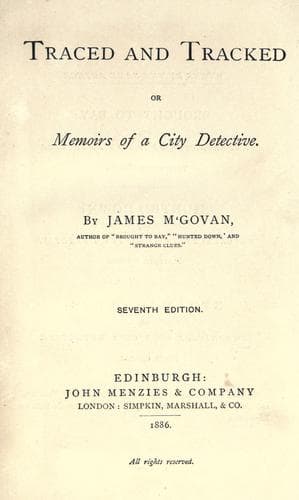
Traced and Tracked; Or, Memoirs of a City DetectiveM'Govan, James
General
Traced and Tracked; Or, Memoirs of a City Detective
M'Govan, James
Detective and mystery stories; Edinburgh (Scotland) -- Fiction
Johnny was kissed by his mother for the brave speech, and the
darkness hid the tear that came with it, though Johnny felt the tear
all the same. It fired his mind and made him blurt out a thought
which otherwise he would have kept in his own head.
“It couldn’t be so very bad to steal a loaf,” he remarked with a
wistful look round on the hungry ones. “I felt near doing it this
mornin’ when a baker asked me to help his board off his heid. The
smell o’ the new bread just took my heart, and I was like to bolt wi’
ane.”
His father’s bony fingers gripped him by the ear, and the touch was
no gentle one.
“If ever you turn thief while I’m living,” he fiercely hissed out,
“never come near me or look me in the face again! I wad rather see
you deid, ay, and mysel’ too,” he brokenly added, with a quiver
getting into his tones.
The boy was moved and awed, and hurriedly answered—
“I ken that, faither, but I couldna help the thought getting into my
heid. I’ll run down to Mr Borland’s, and ask him to trust you two
loaves till your hand gets weel. It’ll be nothing to him; I’ve seen
you bring hame as much into your wages.”
The father remained silent, but after a little pressing and pleading,
said with a weary sigh—
“Do as you please; it’ll sune be a’ ower noo.”
The boy darted out of the house, afraid that his father might change
his mind and command him to stay.
Johnny, be it observed, was in rags, and wore boots which a
cinder-gatherer would have passed in contempt in a dust-heap.
Pinching hunger had given him a haggard and disreputable look, and
all that he wanted to pass for one of my “bairns” were a dishonest
heart and hand.
Ten minutes’ walking brought him to the baker’s shop, which he
thought was Mr Borland’s, but which had been quitted by that master
more than a year before, in favour of one in a better locality.
However, it was a baker’s shop still, and Johnny, noticing no change
in the name, and seeing the place closed, began to knock gently at
the door in hope that the occupant might be still within. There was
no answer, and at length the boy, with a hazy idea that the baker
might live behind the shop, went through a narrow entry to have a
look at the back.
By the dim light he picked out the window of the back shop. There
were bags of flour and shelves of loaves dimly discernible within,
but no light and no human face. A moving thing he did see, and a pair
of shining eyes gruesome enough to have frightened the wits out of
one less hungry, but a steady look for a moment or two showed him
that the living creature was only a cat, which had got shut in, and
was now mewing most piteously, as if imploring to be let out. The
misery of another creature often draws us from our own. Johnny became
interested in the cat, and its desperate scratchings and mewings,
and, after watching it for some time—quite forgetful of the fact that
he might be watched as well—said to himself—
“It would be easy to push up the window and let the puir brute out.”
Public-domain text, read in full here on John Shaqi.
Reviews
Reviews
No reviews yet
Be the first to share your thoughts on this work.
Elsewhere in the archive
Join the Discussion
Join the discussion
Sign in to leave a comment or review.
Sign InorCreate an account