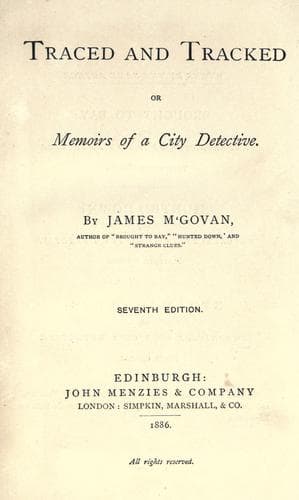
Traced and Tracked; Or, Memoirs of a City DetectiveM'Govan, James
General
Traced and Tracked; Or, Memoirs of a City Detective
M'Govan, James
Detective and mystery stories; Edinburgh (Scotland) -- Fiction
The terrible pinchings which had been endured by that family were
scarcely known outside their own door, for it was believed that
Mossman was getting an allowance off some sick fund or trade society.
There were two boys and three girls, the youngest of these being an
infant at the breast, and the eldest only ten; but these children
were so drilled and trained by their parents in their own spirit of
independence, that not a whisper of the truth reached the neighbours.
“When things are at their worst they begin to mend.” These were the
words of the poor, disabled baker to his wife on this Saturday night,
but as they did not satisfy hungry bairns, a council was held to
accelerate the mending. The house was empty, and the whole family
almost naked, so of late they had been seldom outside the house.
The general messenger was Johnny, the eldest boy, and he it was who
appeared to feel the position most keenly. Johnny was ashamed of his
rags, and had a firm opinion that he was a strong, able-bodied man,
instead of being the skinny little shadow he was, and that his proper
sphere was the sea, to which he had more than once threatened to
run away, not returning till he was a captain all covered with gold
lace, and with a fair share of the same metal in his pockets for his
parents.
“If I was away,” he remarked on the present occasion, “there would
always be one less to eat.”
“We might all say that,” said his father, who had grown somewhat
sharp and fierce with famine and fretting. “I have thought about it
myself often of late. A poor man in trouble and without a friend in
the world would be far better out of it.”
This sentiment was received with a strong and general protest, the
mother especially having got frightened of late at some of the
desperate looks and words of the disabled baker.
“You’re not without friends, if you like to apply to them,” she
remarked, after a pause, to let him cool down a little. “There’s
Borland, for instance, your old companion.”
“He’s a master now,” said Mossman, snappishly.
“So much the better—he may be the readier to help you, for you could
work it up to him when you are well. At any rate, something must be
done to-night, for the bairns canna want ower Sunday.”
“I quarrelled wi’ him over a game at draughts,” said Mossman,
stubbornly, “and I havena spoken to him for ten years, and I winna
now. He’d only crow over me.”
“You were at the schule thegither, and apprentices in the same shop.
I dinna believe he would laugh at ye,” persisted the wife, “but if ye
like I’ll gang mysel’.”
“I winna gang, and I winna let you be seen in such rags,” said her
husband, determinedly.
“I’ll gang then, faither,” eagerly cried Johnny. “I dinna care though
he laughs at me, if he only helps us.”
Public-domain text, read in full here on John Shaqi.
Reviews
Reviews
No reviews yet
Be the first to share your thoughts on this work.
Elsewhere in the archive
Join the Discussion
Join the discussion
Sign in to leave a comment or review.
Sign InorCreate an account