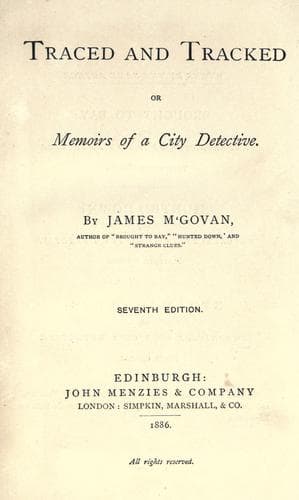
Traced and Tracked; Or, Memoirs of a City DetectiveM'Govan, James
General
Traced and Tracked; Or, Memoirs of a City Detective
M'Govan, James
Detective and mystery stories; Edinburgh (Scotland) -- Fiction
I sent over a posse of men one by one to the marked establishment,
and when Smeaton and his companion appeared and ascended the stair
I followed, and so closed up the retreat. They were not long
gone. We heard the alarm, and some shouting and struggling, and
soon saw Smeaton come scrambling out at the window on the roof by
which he had entered, and come flying along the slates towards the
hatch. As he got close my head popped out in front of him, and he
started—staggered back with an oath—lost his footing, and vanished
over the edge of the roof. He was picked up on the pavement below,
very much injured and quite senseless, and borne on a shutter to
the Infirmary, while his captured companion was marched over to
the Office and locked up. Dinah, in ferocious joy over Smeaton’s
accident, got drunk and disorderly, and was taken to the cells next
day. Smeaton remained for the most part unconscious during two days
and nights. Towards the close of the second day, a cab drove up to
the Infirmary gate, and out of it stepped a young girl, so pale and
feeble that every one thought it was a patient instead of a visitor
who had arrived. It was Jessie Aimers, who had risen from bed and
taken that long journey the moment she heard of the accident. She
was helped in to the ward, and sat there with Smeaton’s hand in her
own till evening, when he opened his eyes for a moment and hazily
recognised her.
“Oh, Jessie, I’ll never rise off this bed,” he feebly exclaimed; and
then, as her warm tears rained down on his cheeks, and her lips were
pressed to his own, he said—“Dinna! dinna dae that! I dinna deserve
it. Pray for me, Jessie, lass; it’s a’ I can ask o’ ye now.”
A screen had been put up round the bed, shutting them off from the
gaze of the other patients, and inside that the nurses glanced
occasionally. They remained there, whispering and communing till
Smeaton relapsed again. Towards morning there was a cry, loud and
piercing, behind the screen, but the night nurse was out of the
ward at the moment. When she appeared, one of the patients spoke of
the cry, and the nurse looked in on the pair. Jessie lay across the
bed with her arms clasped tight about the patient, and her face hid
in his bosom. Smeaton’s face was marble-like, his eyes half open
and fixed. The nurse knew that look at a glance, and called to her
companion that Smeaton was dead, and that she feared the young girl
had fainted. Gently they tried to disengage the clasping fingers,
that they might raise her and restore her to consciousness, but the
deathly coldness of the thin hand caused them both to start back
and exchange a look of inquiry and alarm. They bent over her, they
listened; all was still—still as the grave, still as eternity. Jessie
was dead.
THE WRONG UMBRELLA.
Public-domain text, read in full here on John Shaqi.
Reviews
Reviews
No reviews yet
Be the first to share your thoughts on this work.
Elsewhere in the archive
Join the Discussion
Join the discussion
Sign in to leave a comment or review.
Sign InorCreate an account