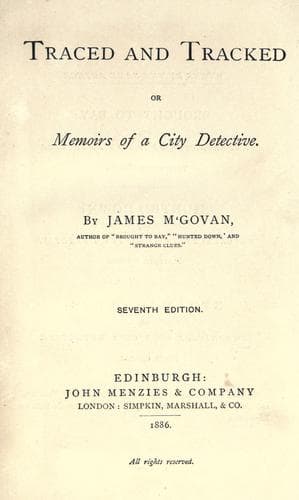
Traced and Tracked; Or, Memoirs of a City DetectiveM'Govan, James
General
Traced and Tracked; Or, Memoirs of a City Detective
M'Govan, James
Detective and mystery stories; Edinburgh (Scotland) -- Fiction
A gentleman drove up to a Princes Street jeweller’s in a carriage or
a cab—the jeweller was not sure which, but inclined to think that it
was a private carriage—in broad daylight, and at the most fashionable
hour. He was rather a pretty-faced young man, of the languid Lord
Dundreary type, with long, soft whiskers, which he stroked fondly
during the interview with the tradesman, and wore fine clothes of the
newest cut with the air of one who was utterly exhausted with the
trouble of displaying his own wealth and beauty. He wore patent boots
fitting him like a glove, and appeared particularly vain of his neat
foot and the valuable rings on his white fingers.
When this distinguished customer had been accommodated with a seat
by the jeweller—whom I may name Mr Ward—he managed to produce a
card-case, and then dropped a card bearing the name of Samuel
Whitmore. The address at the corner at once gave the jeweller a clear
idea of the identity of his customer. The Whitmores were a wealthy
family, having an estate of considerable size in the West, and had,
in addition to the fine house on that estate, a town residence in
Edinburgh and another in England. There was a large family of them,
but only one son; and that gentleman the jeweller now understood
he had the pleasure of seeing before him. He was said to be a fast
young man, with no great intellect, but traits of that kind are not
so uncommon among the rich as to excite comment among tradesmen.
The follies of some are the food of others, and the jeweller was no
sooner aware of the identity of his visitor than he mentally decided
that he was about to get a good order. He was not disappointed—at
least in that particular.
“I want your advice and assistance, Mr Ward, as to the best sort of
thing to give—ah—to a young lady—you know—as a present,” languidly
began the pretty young gentleman. “It must be a real tip-top
thing—artistic, pretty, and all that; and you must be willing to take
it back if she shouldn’t like it—that is, in exchange for something
as good or better.”
“Hadn’t we better send a variety of articles to the young lady, and
let her choose for herself?” suggested Mr Ward.
“Oh, hang it, no!—that would never do,” said Mr Whitmore, with
considerable energy. “She’d stick to the lot, you know; women are
never satisfied;” and he gave a peculiar wink to convey the idea he
wished to express. “You just be good enough to show me the things,
and I’ll choose what I think best, and you can send them to the house
addressed to me. I’ll take them to her myself to-morrow, and if they
don’t suit, I’ll send them back by my valet, or bring them myself.”
Public-domain text, read in full here on John Shaqi.
Reviews
Reviews
No reviews yet
Be the first to share your thoughts on this work.
Elsewhere in the archive
Join the Discussion
Join the discussion
Sign in to leave a comment or review.
Sign InorCreate an account