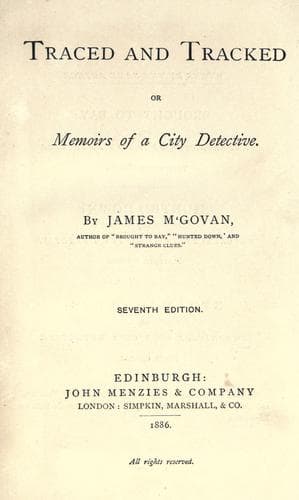
Traced and Tracked; Or, Memoirs of a City DetectiveM'Govan, James
General
Traced and Tracked; Or, Memoirs of a City Detective
M'Govan, James
Detective and mystery stories; Edinburgh (Scotland) -- Fiction
All this was fair and quite business-like, and Mr Ward hastened to
display his most tempting treasures to his customer, who, however,
speedily rejected the best of them on account of their high price.
At length he chose a lady’s small gold lever, ornamented with jewels
on the back, and a set of gold ear-rings, with brooch and necklet to
match. The price of the whole came to a trifle under £60, and the
buyer expressed much satisfaction at the reasonable charges and the
beauty of the articles.
“You will put them up carefully and send them home, and, if I
keep them, you can send in your bill at the usual time,” said the
agreeable customer; and so the pleasant transaction concluded, the
jeweller showed him out, the cab was entered, and Mr Whitmore not
only disappeared from the jeweller’s sight, but also, as it seemed,
from every one else’s. As he left the shop, the languid gentleman had
looked at his watch, and the jeweller had just time to notice that it
was an expensive gold one, with a very peculiar dial of gold figures
on a black ground. Some reference had also been made to diamonds
during the selection of the presents, and Mr Whitmore had been
obliging enough to remove one of the rings from his white fingers
and place it in the hands of the jeweller, when that gentleman read
inside the initials “S. W.”
These two circumstances were afterwards to add to the intricacy
of the case when it came into our hands. From the moment when the
pretty-faced gentleman was shown out by Mr Ward, he could not have
vanished more effectually if he had driven out of the world. Half
an hour after, a young apprentice lad in Mr Ward’s employ took the
small parcel given him by his master out to the stately residence
of the Whitmores at the West End, and, according to his statement
afterwards, duly delivered the same. There was no name-plate upon
the door, but there was a big brass number which corresponded with
that on the card left by the pleasant customer. The messenger, who
was no stupid boy, but a lad of seventeen, declared most positively
that he looked for the number in that fine crescent, rang the bell,
and was answered by a dignified footman. He then asked if the house
was that of the Whitmores, was answered with a stately affirmative,
and then departed. None of the articles thus sent home were returned,
and they were therefore entered in the books as sold. A month or two
later the account was made up and sent to the buyer. There was no
response for many weeks, but at length the answer did come, and in
a manner altogether unexpected. A gentleman, young, but by no means
good-looking, drove up to the shop door one forenoon and entered
the shop. Mr Ward had never seen him before, but the card which he
placed before the jeweller was familiar enough to cause him to start
strangely. It bore the name, “Samuel Whitmore,” with the address at
the lower corner—it was, indeed, the _facsimile_ of that which had
Public-domain text, read in full here on John Shaqi.
Reviews
Reviews
No reviews yet
Be the first to share your thoughts on this work.
Elsewhere in the archive
Join the Discussion
Join the discussion
Sign in to leave a comment or review.
Sign InorCreate an account