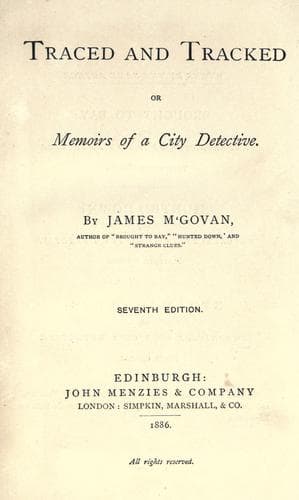
Traced and Tracked; Or, Memoirs of a City DetectiveM'Govan, James
General
Traced and Tracked; Or, Memoirs of a City Detective
M'Govan, James
Detective and mystery stories; Edinburgh (Scotland) -- Fiction
The deacon was a man named Thomas Aikman, a baker by trade, a sharp
business man, who considered himself the main pillar of that church.
He fluttered into the building and showed the distinguished visitor
to his own pew—if pew it could be called—placed books before her, and
returned to the plate. There was an interval during which no other
worshippers entered, and Mr Aikman spent the time in admiring that
bank note as it lay in the plate, contrasting so deliciously with
the thin strata of coppers below. It was a crisp note of the Bank of
Scotland, and so new that it would not remain folded. Of course it
had a number, and that number Mr Aikman declared he could not help
noting, as the paper lay open before him. He did not mark down the
number—did not think of doing so—but he had a good memory, and he
could trust to that, and swear by his convictions.
As he gazed the deacon rapidly ran up in his mind all that this bank
note would do. There was a trifling debt on the building fund, and
this would all but clear it off. There would be no difficulty in
getting the other managers of the church to agree to that; they were
afraid of the stout and pugnacious baker, and always hurriedly agreed
to whatever he thought fit to propose.
While he was settling this matter another stranger appeared, and
placed a silver coin in the plate, at the same time asking to be
shown to a seat. The half-crown which this gentleman dropped into
the plate rested on the bank note already there, and thus the two
contributions were left while the deacon went inside and showed the
gentleman to his own form. Not a minute was occupied in the task,
and during the interval only one person entered the church. That
person was the Rev. Arthur Morrison, who appeared heated and flushed
as he pressed past the deacon and made his way to the little desk
from which he preached. Mr Aikman went straight back to his post at
the plate, and the bank note being still prominent in his thoughts,
he glanced at once in that direction. Then he started and rubbed
his eyes. He himself had been the last to leave the spot—for the
gentleman had preceded him into the church—and then the bank note lay
in the plate all right, with the half-crown safely weighting it; now,
when he got back, the note was gone. The half-crown was there—shining
like a white disc among the coppers, but not a vestige of paper money
was near it. The deacon looked around. There was no wind, but the
note might have got over the edge of the plate, and fallen to the
ground. No; it was not in the vestibule. Aikman darted outside; there
was not a human being in sight. He staggered back again and stared
at the plate till his goggling eyes might have speared a hole in it.
There could be no doubt about it—the church had been robbed, and was
the poorer by £5 of the deacon’s momentary absence. He had no one to
advise or assist him, the other deacon on the list having failed to
appear, and felt doubly angry and excited over the strange loss from
Public-domain text, read in full here on John Shaqi.
Reviews
Reviews
No reviews yet
Be the first to share your thoughts on this work.
Elsewhere in the archive
Join the Discussion
Join the discussion
Sign in to leave a comment or review.
Sign InorCreate an account