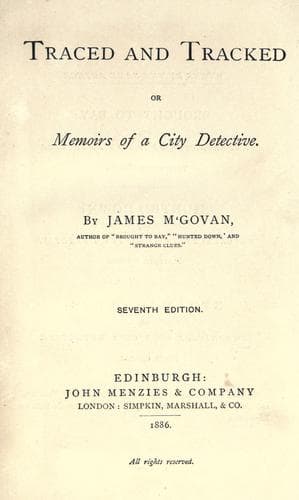
Traced and Tracked; Or, Memoirs of a City DetectiveM'Govan, James
General
Traced and Tracked; Or, Memoirs of a City Detective
M'Govan, James
Detective and mystery stories; Edinburgh (Scotland) -- Fiction
having already mentally decided how the money should be utilised.
He was in a fever of bewilderment, perspiring in every pore, and
even madly thrusting his hands into his own pockets to make sure
that the note had not fluttered in there. Then, after another dart
outside to make sure that no prowling thief could have been near,
the deacon did a little mental reasoning. No one, so far as he was
aware, had entered the church during his absence from the plate but
the minister. Could it be possible? No, never! Well, yes it might
be. The man was poor and needy, and he might consider the drawings
at the door as in a manner his own, or intended for him. Mr Aikman
had an old grudge at his minister, who had once dared not only to
correct him on some theological points, but had satirized him in a
quiet way as well. The man who could utter a joke at the expense
of a great man like Aikman was fit for anything, and the bank note
could not have gone without hands. The deacon began to understand the
whole mystery, and put up the collection and closed the door to go
inside and listen to the sermon in no frame of mind to profit by the
discourse. At every telling point in the oration Aikman turned up his
nose, and mentally exclaimed—
“How can he, with that stolen £5 note in his pocket!”
On the whole, the deacon felt more of pity than of anger at the cool
appropriation, but he determined that the minister should know that
the robbery had been discovered. How best to make the revelation
exercised Aikman’s small brain pretty closely during the service. He
had not quite settled the matter when the benediction was pronounced.
As the lady who had made the handsome gift handed him back the books
she had used, and made some remarks about the church, a happy idea
struck the deacon. He boldly thanked her for her liberality, and then
concluded by asking her—much to her surprise—if she knew the number
of the note she had put in the plate. She did not; and as she was too
polite to ask the reason for inquiry, no more passed between them,
and the lady departed and was seen no more. Had Mr Aikman been of a
less active disposition the matter might have ended there. No one had
seen the bank note but himself, and it was now gone through no fault
of his. But then there was the minister, and the suspicion, and his
own old grudge. He could not remain passive.
When all the congregation were gone Aikman steadily fixed the young
clergyman with his ferocious eye, and said—
“There was one lady very good to us to-day—she put a £5 note in the
plate.”
A slight flush overspread the pale face of the young preacher, and he
said a little hurriedly—
“Ah, indeed? I am pleased to hear that. Excuse me just now; I must
hurry home.”
He moved away abruptly, and the deacon stood staring after him, now
thoroughly convinced of the soundness of his suspicions.
Public-domain text, read in full here on John Shaqi.
Reviews
Reviews
No reviews yet
Be the first to share your thoughts on this work.
Elsewhere in the archive
Join the Discussion
Join the discussion
Sign in to leave a comment or review.
Sign InorCreate an account