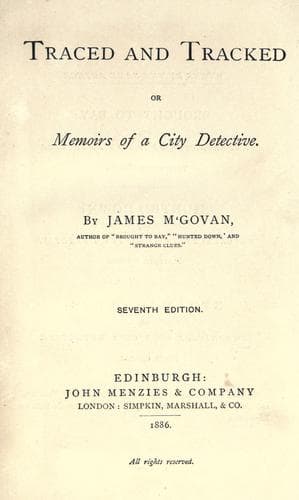
Traced and Tracked; Or, Memoirs of a City DetectiveM'Govan, James
General
Traced and Tracked; Or, Memoirs of a City Detective
M'Govan, James
Detective and mystery stories; Edinburgh (Scotland) -- Fiction
There was no time to elaborate theories or schemes of capture. A gold
watch and chain valued at about £30, and £14 in money, were gone.
A rare prize was afloat among the sharks, and I surmised that the
circumstance would be difficult to hide. The thief and the honest
man are alike in one failing—they find it difficult to conceal
success. It prints itself in their faces; in the quantity of drink
they consume; in the tread of their feet; the triumphant leer at
the baffled or sniffing detective, and in their reckless indulgence
in gaudy articles of flash dress. I went down to the Cowgate and
Canongate at once, strolling into every likely place, and nipping
up quite a host of my “bairns.” I thought I had got the right men
indeed when I found two known as “The Crab Apple” and “Coskey” flush
of money and muddled with drink, but a day’s investigation proved
that they owed their good fortune to a stupid swell who had got
into their clutches over in the New Town. Coskey, indeed, strongly
declared that he did not believe the Anderson affair had been managed
by a professional criminal at all.
“If it had been done by any of us I’d have heard on it,” was his
frank remark to me.
I was pretty sure that Coskey spoke the truth, for in his nervous
anxiety to escape Calcraft’s toilet he had actually confessed to
me all the particulars of the New Town robbery by which his own
pockets had been filled, and which afterwards led to a seven years’
retirement from the scene of his labours.
The hint thus received prepared me for making the worst slip of all
I had made in the case. I went to Anderson’s widow to get the number
of the watch, and some description by which it might be identified.
She could not tell me the number or the maker’s name; she could only
say that it had a white dial and black figures, but declared that she
would know it out of a thousand by a deep “clour” or indentation on
the back of the case.
“I was there when it got the mark,” she said, “and I could never be
mistaken if the watch was put before me. A thief might alter the
number, but nobody could take out that mark, for we tried it, and
the watchmaker could do nothing for it. My man was working hard one
day with the watch on, when a customer called to be measured. The
waistcoat he wore wasn’t a very bonny one, and he whipped it off in
a hurry, forgetting about the watch, which was tugged out, and came
bang against the handle of one of his irons. The watch was never
a bit the worse, but the case had aye the mark on it—just there,”
and the widow, to illustrate her statement, showed me a spot on the
back of my own watch, and then so minutely explained the line of the
indentation, its length and its depth, that I felt sure that if it
came in my way I should be able to identify it as readily as by a
number.
This would have been all very well if her information had there
ended, but it didn’t.
Public-domain text, read in full here on John Shaqi.
Reviews
Reviews
No reviews yet
Be the first to share your thoughts on this work.
Join the Discussion
Join the discussion
Sign in to leave a comment or review.
Sign InorCreate an account