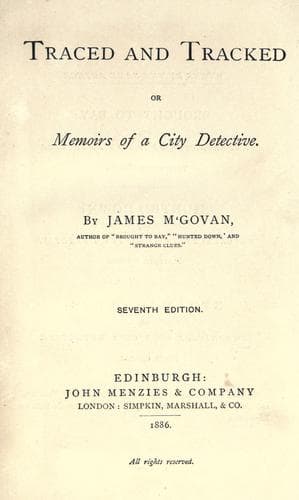
Traced and Tracked; Or, Memoirs of a City DetectiveM'Govan, James
General
Traced and Tracked; Or, Memoirs of a City Detective
M'Govan, James
Detective and mystery stories; Edinburgh (Scotland) -- Fiction
The next day I had a visit from the young minister, in at the
Central, in Edinburgh. I have but a faint recollection of the
interview, but I remember that he appeared greatly excited and
agitated, and ended his somewhat incoherent statement of the facts
by imploring me to take up the case with a view to—what think
you?—with a view to convicting Mr Aikman of perjury or conspiracy!
The reasoning of the young clergyman was this:—No one but the deacon
had seen a £5 note in the plate, and he alone had reported the note
stolen—therefore the note might never have been there at all! From
this followed the deduction—the deacon from his old grudge had got up
the whole as a revenge on the young preacher to injure his reputation
and force him out of his post. In consequence of this appeal I went
out to the place and made some inquiries, but was met almost at the
outset with clear proof that a £5 note had been put into the plate.
The lady who had been the donor was gone, but at the hotel in which
she had been staying the landlord had heard her mention the gift to
her husband.
The case was tried shortly after at the Burgh Court, the accused
conducting his own case. From the evidence led few could doubt
the guilt of the poor preacher the deacon was so cool, and clear,
and positive in all his statements. On one point alone did he show
confusion, and that was regarding his noting the number of the note
while it lay in the plate. Here the deacon, from his very evident
desire to make all clear and firm, contradicted himself slightly, and
then floundered worse under a very simple question from the Sheriff,
and was put down in confusion. The result was that the case was
dismissed—quite an unsatisfactory result to both parties. The deacon
was enraged—having recovered from his momentary confusion, and being
now ready with a clear and minute explanation—and the poor minister
was quite broken down under the disgrace. When he returned to the
town which had brought him so much suffering, he met with so many
cold looks from those whom he had believed to be his warmest friends,
that he was almost forced to resign his charge. The resignation
was accepted with a promptitude even more crushing to his spirit;
and then, while he was making preparations to leave the place, his
creditors swooped down on his few possessions, and left him and his
family with little but the clothes in which they stood.
Public-domain text, read in full here on John Shaqi.
Reviews
Reviews
No reviews yet
Be the first to share your thoughts on this work.
Elsewhere in the archive
Join the Discussion
Join the discussion
Sign in to leave a comment or review.
Sign InorCreate an account