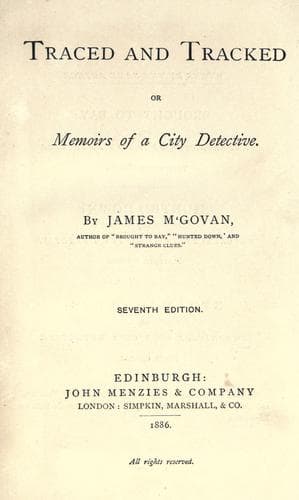
Traced and Tracked; Or, Memoirs of a City DetectiveM'Govan, James
General
Traced and Tracked; Or, Memoirs of a City Detective
M'Govan, James
Detective and mystery stories; Edinburgh (Scotland) -- Fiction
“I got it on Saturday afternoon,” answered the suspected man, with
calm dignity. “It came to me in an envelope, by post, and without
a line to indicate the sender. There were a few words written
inside the flap of the envelope, which I had not noticed when I put
the envelope in the fire. I snatched it out again and read them.
They were—‘For the little ones, from a well-wisher.’ I was quite
overpowered,” continued the young preacher, with a quiver in his
tones; “I had seen nothing but darkness and trouble before me, as one
of my creditors was pressing me sorely for money, knowing perfectly
that I had none. I went to God with my trouble in prayer, and that
was His answer.”
The deacon was horrified. That the minister should steal the note
he could readily understand, but that he should account for its
possession in such a manner showed a depth of depravity and a
hypocrisy which he had not conceived possible to dwell in man.
“You have the envelope, of course?” he sneeringly observed, after a
significant silence.
“No; unfortunately I have not. I put it into the fire in case my
wife should see it, and—and be pained by the thought of me having to
accept such help from an unknown friend.”
The deacon looked at the constable with a significant jerk of the
head. It was quite evident they could make nothing of a man so lost
in wickedness, and so ready with plausible excuses. The constable,
however, appeared to be foolishly overcome by the cunning reply of
the culprit, and made no remark. It therefore devolved upon Aikman to
make a noble stand for honesty and religion.
“Mr Morrison,” he impressively began, “that bank note which you paid
to Blackie the grocer was put in the plate on Sunday by a lady. I
saw it, and read the number of it as it lay. After you had passed
the plate, it had vanished. Either admit your crime, or take the
consequences.”
“Now—at last—I understand you,” answered the minister, with more
dignity and calmness than his accuser. “You accuse me of stealing the
bank note?”
“We do, upon the clearest evidence,” snorted the deacon.
“Then I deny it emphatically,” said the accused, almost smiling. “I
cannot believe you to be in earnest. Steal it! why should I do that?
It was put there for the general benefit of the church, I suppose,
and that includes me, doesn’t it?”
“So you thought when you took it, I’ve no doubt,” angrily returned
Aikman, “but you will find yourself grievously mistaken. Constable, I
charge that man, in the name of the managers, with the theft of £5.
Do your duty.”
Matters had now become serious, but the gentleness of the constable
smoothed away much that might have been painful.
They walked together to the house of the Fiscal, and, after an
account of the circumstances had been gone over, the young minister
was allowed to go back to his home on his own recognisance.
Public-domain text, read in full here on John Shaqi.
Reviews
Reviews
No reviews yet
Be the first to share your thoughts on this work.
Elsewhere in the archive
Join the Discussion
Join the discussion
Sign in to leave a comment or review.
Sign InorCreate an account