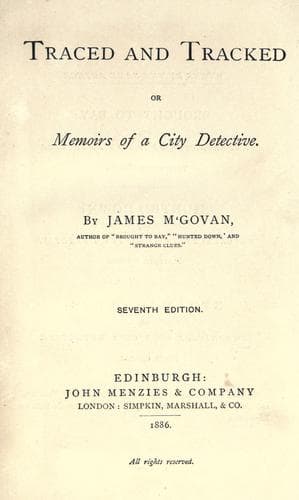
Traced and Tracked; Or, Memoirs of a City DetectiveM'Govan, James
General
Traced and Tracked; Or, Memoirs of a City Detective
M'Govan, James
Detective and mystery stories; Edinburgh (Scotland) -- Fiction
I remembered the case then, and immediately set about tracing
Morrison, a task which would have been easy indeed if I had thought
for a moment of him being identical with “the broken missionary.” At
length I came upon a solicitor who occasionally employed Morrison to
copy deeds, and by him was referred to the tradesman who employed
the broken man to keep his books. It was only when we were near the
hovel which Morrison called his home that the idea flashed upon me
that the broken missionary was the man I was after. I knew where he
lived, and went straight to the house, which tallied perfectly with
the description given by the tradesman.
When we knocked at the door a low voice told us to “Come in,” and on
entering we saw only a child of eighteen months creeping about the
floor in great glee, with a doll of rags in its hands. But a glance
round showed us where the voice had come from. There was a bed behind
the door, and in that there was a pale, bloodless face, and a pair
of shiny eyes, bearing a shadowy resemblance to the man we sought.
The broken missionary feebly attempted to raise himself upon his arm,
while the deacon rushed forward, dropped on his knees before the bed,
and hid his face and tears in the thin wasted hands he had clasped.
“My poor wronged minister!” he exclaimed; “say you forgive me. We
have found out the lady who sent you the £5 note; and I know I have
been cruel and wicked——”
A strange convulsion passed over the ghastly face and sunken features
of the missionary, while his great eyes appeared to shine out with a
perfect radiance.
“Bless the Lord, O my soul, and all that is within me bless his holy
name!” he fervently exclaimed, as the great eyes became soft and
beautiful with tears.
The child on the floor crowed with delight, and hammered vigorously
on the floor with the head of its doll of rags. The deacon gathered
the thin form of the sick man in his arms, and hurriedly breathed out
all his plans for reparation. He would carry him back with him to his
own home; he would care for him, and send him away to the country, to
fresh green fields and cool shady woods, where he would have nothing
to do but take his fill of the balmy air, and draw health from the
glorious sunshine. But the grey head was shaken on his breast in
quiet demur, with a pitiful look in the great eyes as they rested on
the laughing face of the neglected child on the floor.
“I am going to fair fields and a glorious country,” he feebly gasped,
“but not there—not there. God has sent his sunshine into my soul, and
I can depart in peace.”
He fainted away as he spoke, and it was long before he could be
restored. The deacon had a nurse and a doctor there in an hour, but
they came too late. In the dead of night, with the deacon clasping
his hand and wetting it with his repentant tears, the missionary went
quietly to his rest.
Public-domain text, read in full here on John Shaqi.
Reviews
Reviews
No reviews yet
Be the first to share your thoughts on this work.
Elsewhere in the archive
Join the Discussion
Join the discussion
Sign in to leave a comment or review.
Sign InorCreate an account