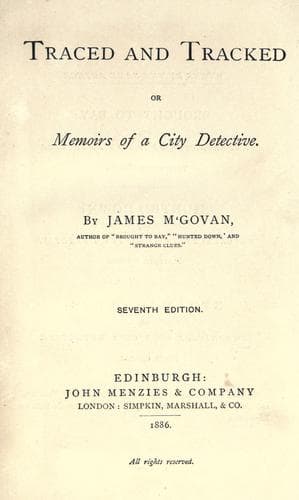
Traced and Tracked; Or, Memoirs of a City DetectiveM'Govan, James
General
Traced and Tracked; Or, Memoirs of a City Detective
M'Govan, James
Detective and mystery stories; Edinburgh (Scotland) -- Fiction
The child was taken to the deacon’s house, and trained and
educated, and finally sent to college, and now promises to occupy a
distinguished position in the profession which proved so disastrous
to his father.
The stolen bank note was never traced, but it was believed to have
been taken by a woman who had acted as chapel-keeper, and who was
afterwards sent to prison for a theft quite as mean, though less
disastrous in its results.
A MURDERER’S MISTAKE.
A toll-keeper on the main road some miles south of Edinburgh was
standing at his open door watching the gambols of his two children,
when a weary traveller approached and arrested his gaze. There
was something uncommon about the dusty tramp when his appearance
could rouse interest in an old toll-keeper, accustomed to look
with indifference on every kind of wanderer that God’s earth can
produce. This one was an old man, tall and gaunt and white-haired.
So far there was a bond of interest between them, but with age the
comparison ceased, for the toll-keeper was stout and well-clad, and
had a comfortable expression beaming from every part of his face;
while the stranger was haggard, worn, and drooping, like one who
had got all that earth was likely to give, and did not care how
soon the giving ceased. Above the toll-keeper’s happy face was a
ticket intimating that he was licensed to sell tobacco; while in
one window a few bottles of confections and biscuits, and the words
“Refreshments and Lemonade” on a show card, summed up his efforts at
trading. The dusty tramp halted in front of the toll-keeper, giving
the stout man a full view of his poor clothing and fragile boots,
from which his toes were peeping, and his sharp eyes eagerly devoured
the intimation above the doorway.
“Good evening, sir,” he said quietly, as he fumbled among his clothes
for a pocket, and at length produced a penny.
The toll-keeper in general was gruff enough with tramps, even when
they seemed disposed to buy his wares, but there was a ring in the
tones of this one which struck a chord of pity in his breast, and
he returned the greeting kindly. In front of the window showing
the biscuits and sweets was a wooden bench. The haggard one limped
towards this bench, saying in the same quiet tones—
“Might I rest for a bit on this bench?”
There was nothing arrogant or bold in this request, but rather a ring
of indifference or despair. It was as if he had said—“It doesn’t
matter whether you say yes or no, or whether I sit down or move on,
or drop dead by the way. The end is not far off either way.”
“Oh, ay, sit as lang as ye like; ye’re welcome,” said the
toll-keeper, heartily. “You look like you had come a far way?”
“I have, sir—a matter of four hundred miles,” said the white-haired
tramp, knitting his brows; then recovering himself, he said in his
former quiet tones, “I suppose you couldn’t let me have a penn’orth
of tobacco? I’ve on’y a penny left.”
Public-domain text, read in full here on John Shaqi.
Reviews
Reviews
No reviews yet
Be the first to share your thoughts on this work.
Elsewhere in the archive
Join the Discussion
Join the discussion
Sign in to leave a comment or review.
Sign InorCreate an account