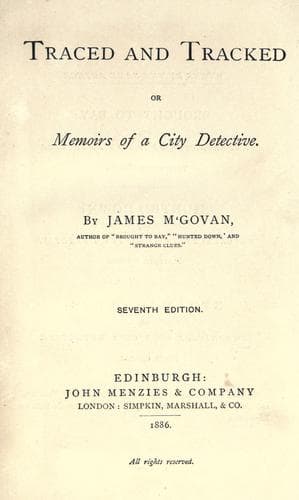
Traced and Tracked; Or, Memoirs of a City DetectiveM'Govan, James
General
Traced and Tracked; Or, Memoirs of a City Detective
M'Govan, James
Detective and mystery stories; Edinburgh (Scotland) -- Fiction
The notes were readily identified by the builder by the number
“2020” which one of them bore; but when we came to look for Morley,
he had vanished. From another country he afterwards sent a detailed
confession of the circumstances which led to the crime. The payer of
the money was dressed as a working man, and asked at the gate for Mr
Lockyer. Morley at once conceived a suspicion that the man had come
after the post of yard-keeper, and applied his eyes and ears to the
inner door in the tool-house to ascertain the truth. He saw the notes
placed in the desk, and the temptation followed, for he had found a
key shortly before in the tool-house which fitted the lock perfectly.
After taking the notes he dropped the key into a street “siver,” or
we might have stumbled on it during our search. Tim was set free, but
he has not yet developed into a detective.
CONSCIENCE MONEY.
An old man, a jobbing gardener, named Alexander Abercorn, stopped one
of the day policemen at the West End one morning in July, and said in
great concern and agitation—
“Man, I’m afraid this house has been robbed in the night time. And
the worst of it is I have the keys, and they’ll be sure to say it’s
been done by me.”
The house in question was a big one known as the Freelands, and
occupied by a Mr Arthurlie and his family. The family were gone
to country quarters, and the house was empty even of servants.
Abercorn hurriedly explained, what indeed was already known to the
policeman, that he had a contract for doing the gardening about the
place, and, being a tried and trusted man, had been left with the
keys of the place, with orders to enter it every day to see if all
was safe. Other families had left him a similar charge, and he had
some half-dozen bunches of keys, which he showed to the policeman
in confirmation. Hitherto his task had been easy, and the result
satisfactory enough, but now for the first time a calamity had come,
and he begged the officer to step in and see. They entered the house,
and the old gardener walked straight to the pantry, in which was
built an iron safe for containing the plate and valuables of the
family. This safe was inserted bodily into a large cupboard, which
had an ordinary wooden door fastened with a common sixpenny lock,
and so looked innocent enough outside. The wooden door stood wide
open, and so also did that of the iron safe within, though both had
hitherto been locked.
Public-domain text, read in full here on John Shaqi.
Reviews
Reviews
No reviews yet
Be the first to share your thoughts on this work.
Elsewhere in the archive
Join the Discussion
Join the discussion
Sign in to leave a comment or review.
Sign InorCreate an account