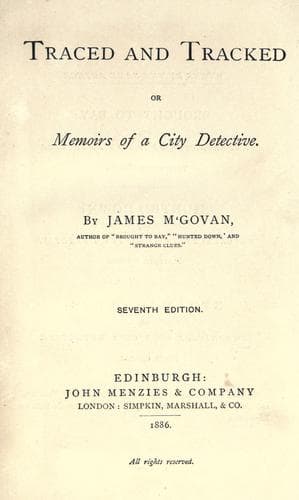
Traced and Tracked; Or, Memoirs of a City DetectiveM'Govan, James
General
Traced and Tracked; Or, Memoirs of a City Detective
M'Govan, James
Detective and mystery stories; Edinburgh (Scotland) -- Fiction
There were no breakages, or marks of prising with crowbars or
chisels—the door appeared to have been opened in the ordinary way,
by inserting a key and turning back the bolts of the locks. The
detectors on the lock of the safe showed that no skeleton keys had
been applied or used, and yet the old gardener declared that the
key of the safe had never been intrusted to him. He did not know who
had it, or where it was kept. He had the keys of all the rooms, and
also the key of the press in which the safe was built, but not the
actual key of the safe. The entire contents of the safe had been
turned out on the pantry floor, and the thieves had then shown great
discrimination in the selection of their plunder. None of the plated
articles had been removed; only genuine silver, and, as some of these
exactly resembled each other, the thieves had shown a skill almost
magical.
The old gardener, of course, knew nothing of what had been in the
safe; and, seeing the plated articles littering the floor, he only
said he _thought_ the place had been robbed. It was only after word
had been sent to the Central Office, and we had telegraphed to the
Arthurlies, that we learned that the value of the silver plate alone
was upwards of £500, and that there had been in the safe other
articles of value which brought the total loss nearly up to £800.
Within an hour of the report being sent in, I was out at the house,
and was shown over the various rooms by the old gardener. To say
that the old man looked excited and strange would be but faintly to
describe his appearance. He was deathly pale; he trembled at the
slightest question or look; his teeth chattered when he spoke; and
he gave the most stupid and confused answers to some of the simplest
queries. I had not been long in the premises when I found that there
were several peculiarities about the robbery which marked it off from
the ordinary burglary. There were three doors to the house. Two of
these—the area door and the back door—had never been touched. They
were bolted and locked just as they had been left. No window had been
forced; every one was closed, and fastened, and shuttered exactly as
it had been left. This narrowed the means of ingress to one door—the
main door, which was secured by two patent locks. It was the keys
of these locks which the old gardener carried and used in entering
the house. I examined these locks closely, and when done, decided
that they had not been opened with skeleton keys or tampered with
in any way; either the door had been left unlocked, or the keys, or
duplicates of these keys, had been used in effecting an entrance.
The second peculiarity was that no room in the whole house of three
storeys had been entered but the pantry. There had been no rummaging
through bedrooms for valuables, no turning out of rare china and
curiosities in the drawing-room, though there were articles of that
kind there far exceeding in value the plate stolen. The thieves
Public-domain text, read in full here on John Shaqi.
Reviews
Reviews
No reviews yet
Be the first to share your thoughts on this work.
Elsewhere in the archive
Join the Discussion
Join the discussion
Sign in to leave a comment or review.
Sign InorCreate an account