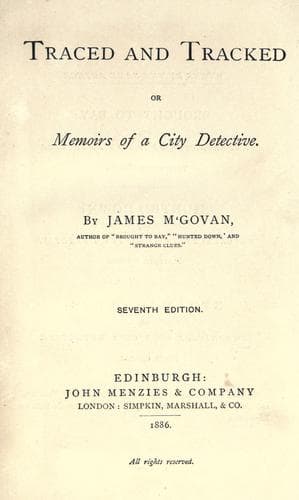
Traced and Tracked; Or, Memoirs of a City DetectiveM'Govan, James
General
Traced and Tracked; Or, Memoirs of a City Detective
M'Govan, James
Detective and mystery stories; Edinburgh (Scotland) -- Fiction
This gentleman was still in the town, though not stationed in the
Prison, and knowing something of the vows of a priest, I despaired
at once of extracting anything from him, but became possessed of a
desire to have a look at his handwriting. Accordingly I sent him
a polite note requesting him to send me word when he would be at
liberty to see me for a few minutes’ conversation. I fully expected
to get a written note in reply, however short, but instead I got a
message delivered by the servant girl, to the effect that her master
was at home, and would see me now. I grinned and bore it, though it
is not pleasant to feel eclipsed in cunning by anyone. I went with
the girl, and found the priest, a pale, hard-worked looking man,
leaning back in his chair exhausted and silent, and certainly looking
as if he at least did not eat the bread of idleness. I felt rather
small as I introduced myself and ran over the case that had brought
me there, he listening to the whole with closed eyes, and a face
as immovable as that of a statue. When I had finished there was an
awkward pause. I had not exactly asked anything, but it was implied
in my sudden pull up, but for a full minute there was no response.
At last he opened his eyes—and very keen, penetrating eyes they
were—and, fixing me sternly with his gaze, he said—
“Did you ever come in contact with a Catholic priest before Mr
M^cGovan?”
“Frequently.”
“Did you ever know one to break his vows and reveal the secrets of
heaven?”
“Never.”
“Do you think one of them would do it if you asked him?”
“I think not.”
“Do you think he would do it if you threatened him with prison?”
“Scarcely.”
“Or with death—say if you had power to tear him limb from limb, or
torture every drop of blood from his body?”
“I don’t know—I shouldn’t like to try.”
“Then what do you come to me for?” he sharply continued, with a
slight tinge of red in his pale cheeks. “Am I, think you, more
unworthy than any other that has yet lived?”
“No, I should hope not,” I stammered; “and I did not come expecting
you to reveal what was told you in confession——”
“What then—you wish to know if I wrote that letter maybe?”
“Yes.”
“And you’ll be satisfied that I speak the truth when I answer?”
“Yes.”
“And you’ll ask no more?”
“I’ll ask no more.”
“Then I didn’t. Bridget, show the gentleman out.”
I was so staggered and nonplussed that I was in the street before
I had time to ponder his reply. I was convinced then, as I am now,
that the priest spoke the literal truth; how then had the letter been
written? Certainly not by O’Doyle himself. Was it possible that a
third person could have got at the information?
Public-domain text, read in full here on John Shaqi.
Reviews
Reviews
No reviews yet
Be the first to share your thoughts on this work.
Join the Discussion
Join the discussion
Sign in to leave a comment or review.
Sign InorCreate an account